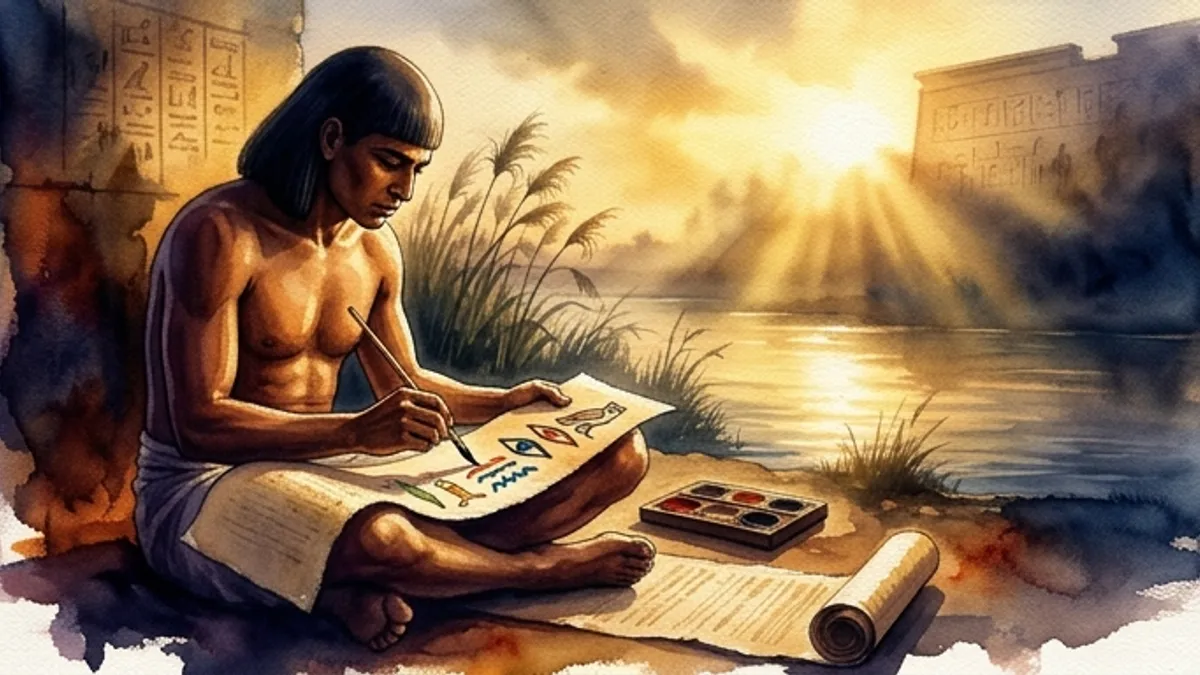
Picture a long stone wall in the Egyptian heat, covered from top to bottom with small, careful images. A heron stands on one leg. An eye looks out beside a coil of rope. A bread loaf sits under a reed. Nothing moves, and yet the whole surface seems to be talking. Someone could read it once, fluently, the way you read this sentence. For a very long time afterwards, nobody could. In the Fourth Great Lesson, this is a moment to stop and ask a child a strange question: can a picture speak?
A wall full of voices
About five thousand years ago, people living along the Nile began to write with pictures. Much later, Greek visitors called these signs “hieroglyphs”, sacred carvings, because they saw them cut into the walls of temples and tombs. But the signs did not only live on stone. They were painted in bright colours, and scribes wrote them with fine reed brushes on papyrus, a kind of paper made from the very reeds that grew along the river. The Nile gave the people water, food and fields, and it also gave them something to write on.
What makes this writing so intriguing to children is that a picture did not always mean what it showed. A sign could simply be the thing itself: a drawn house meant a house. The same kind of sign could also point to an action connected with it, as a pair of walking legs might suggest going. And sometimes a picture stood only for a sound, with no meaning of its own at all. The owl, for instance, was often used for the sound “m”. A reader had to work out, from the context, which job each picture was doing.
No wonder scribes trained for many years. There were hundreds of signs to master. Children tend to be delighted by two further details. First, the names of kings and queens were written inside an oval frame shaped like a loop of rope, which we now call a cartouche. Almost immediately someone asks, “What would my name look like?” Second, the people and animals in a line of signs all face towards its beginning. They quietly show the reader which way to go.
Then the knowledge faded. Over the centuries the last readers were gone, and the walls kept speaking to no one. Only when the Rosetta Stone was found, carrying the same text in three different scripts, could patient scholars begin to compare them. In 1822 Jean-François Champollion announced that he had understood how the system worked. Voices silent for more than a thousand years could be heard again.
Not understanding yet
There is a child in your life, perhaps, who is just beginning to read. For them, a page of print is not so different from that temple wall. The shapes are clearly meant to say something; they simply do not open yet. It is easy for adults to forget how that feels. The hieroglyphs give us a gentle way to remember. Standing before a script we cannot read, we become beginners again, and we may notice that the feeling is not only frustration. It is also curiosity. Not understanding yet is where discovery starts.
The story invites gratitude too. Behind every sign stand countless people: those who first thought a picture could carry a sound, the teachers who passed on hundreds of shapes, the scribes who copied texts with steady hands, and the scholars who, much later, refused to give up on a forgotten language. When a child writes their own name, they are drawing on all of that work, most of it done by people whose names we will never know.
And the hieroglyphs show that order and beauty can belong together. The signs are arranged with care and balance, yet they follow firm rules about direction and meaning. Children often sense this without being told. Beauty is not decoration added afterwards; it grows out of attention to how things fit. Perhaps, at the end, you might wonder aloud with the child: with so many signs, was there not a simpler way? The story of the alphabet is already waiting.
Try this together: Invent a small picture script as a family or class. Agree on a few signs: one that shows a thing (a sun), one that stands for an action (a pair of feet for walking), and one that stands only for a sound (perhaps a bee for “b”). Write a short message with them and hand it to someone who was not in the room. Can they decode it? Afterwards, talk about which signs were easy to read and which caused confusion, and why.
Which pictures speak to you every day without a single word: a road sign, a symbol on packaging, a small icon on your phone? How did you learn what they mean, and who might still find them as puzzling as an Egyptian wall once seemed to everyone?