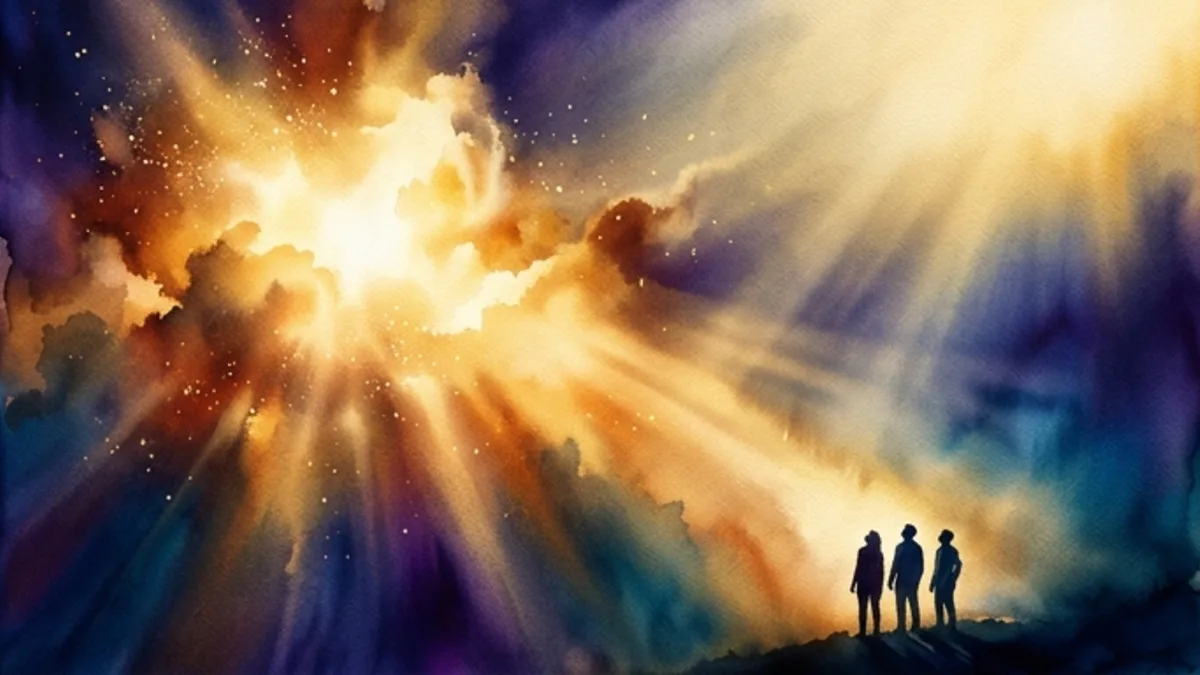
Before a single particle begins to move in the First Great Lesson, a sentence is already standing in the room, and it sounds like a riddle: “God Who Has No Hands.” No child hears that title and stays indifferent. It asks something straight away that nobody in the circle has a ready answer for: how can anything come into being if there is no one there to shape it with hands? And that is exactly how this story opens — not with an explanation, but with a wonder larger than any piece of information the grown-ups could hand over.
The riddle standing at the beginning
The lesson does not start with physics. It starts with people. In every age, it says, human beings have sensed something greater than themselves, and they carried that feeling to the wise ones of their time. The answers they were given are peculiar: above all they describe what this great thing does not have. No eyes. No hands. No feet. And yet everything that exists has come to be — and has held ever since in an order nobody needs to repair. A name that describes what is missing, and makes a marvel out of it.
Then something remarkable happens. The story does not argue. It defends its own title with not a single argument. It simply lets the question stand and begins to tell: of a darkness beside which our night is broad daylight, of a cold beside which ice feels warm, of a glowing cloud that held everything which is now star and stone and water. The riddle turns into a story rather than a quarrel. It is a decision that is easy to read straight past: the title claims nothing it would have to prove. It only opens a room, and leaves it to the children to step inside.
Tell this opening to children and you can watch how differently they fill it. One says quietly: “That’s God.” Another calls out: “That was the Big Bang, we saw it in a film!” A third says nothing at all and simply looks at the dark cloth in the middle of the circle. And here is the beautiful part: the story contradicts none of them. It has room for the child from a devout family and for the child who never hears a prayer at home. What all three share is not the same conviction but the same moment — that short pause in which something grows too large to be explained away quickly.
Why the question is allowed to stay open
That the title is so open is neither accident nor oversight. Maria Montessori worked the Great Lessons out during the years she spent in India, surrounded by children from Hindu, Muslim, Christian and many other families. A story meant to serve all of them could not be a doctrine. It had to be a door — one that every child walks through carrying whatever they bring from home.
So you may speak the name differently if it sounds foreign in your group or your family. Some tell of “the great mystery”, others of “the force at the beginning”, others stay entirely with the laws the particles obey. What is not up for negotiation is not the word but the posture behind it: reverence rather than instruction. Children sense at once whether we are selling them an answer or still marvelling ourselves. It only becomes delicate when we plug the open place — with whatever material. Fill it with an article of faith and you shut out the children who do not share it. Fill it with a quick formula from a science book and you take the story’s breath away. Both times the same thing is lost: the feeling of standing before something bigger than your own explanation.
Children between six and twelve are asking these questions anyway. Where does all of this come from? Why is there anything at all? Where was I before there was me? Answer too fast and we close a door that has only just swung open. “Let us give the child a vision of the whole universe,” Montessori wrote — a vision, not a fact sheet. The most honest sentence you can offer in such a moment is often the shortest: I don’t know. It costs you nothing of your reliability. It gives the child something far more valuable — permission to keep asking. As a supplementary resource for the Montessori practice, that permission may be the most useful thing this lesson puts in your hands.
Try this today: collect the questions instead of answering them. After the telling, every child gets a slip of paper for the question that stayed in their head — whoever cannot write yet can draw it instead. Pin the slips to a wall or drop them into a box, and take them out again over the following weeks. Some questions resolve themselves. Others simply stay. Both are a good result.
When did you last say “I don’t know” to a child — and how did it feel? Which large question are you still carrying around with you, and what would change if you saw it not as a gap but as an open window?