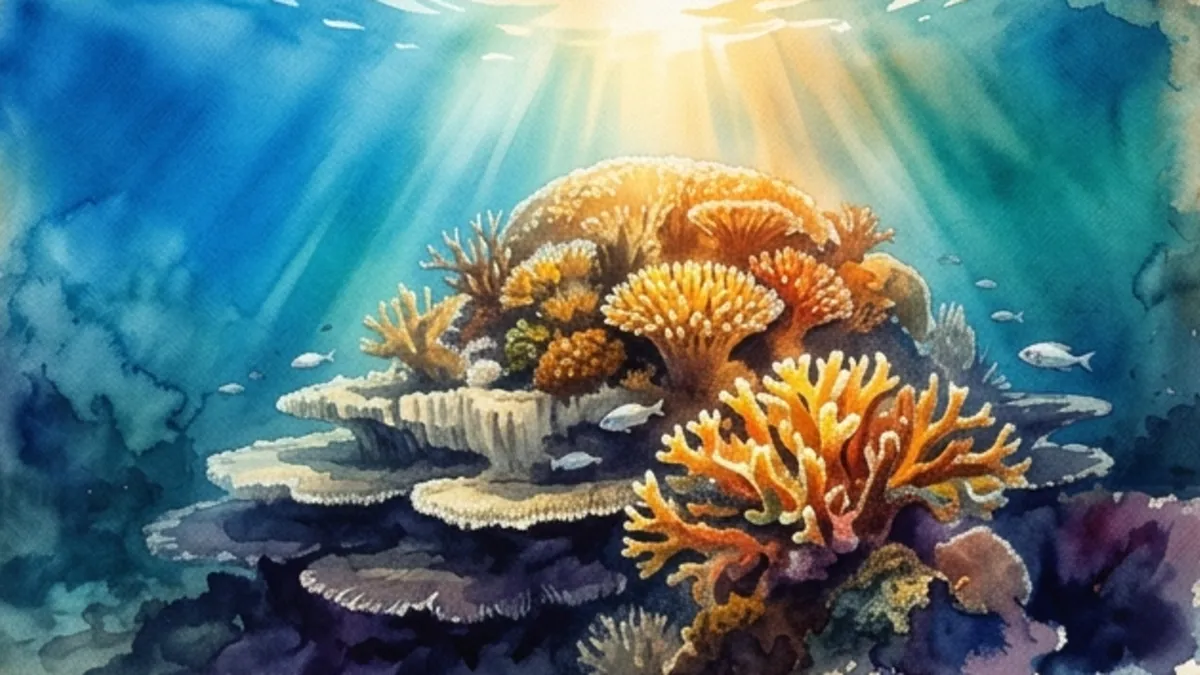
The largest structure ever raised by living creatures on this planet was not made by people. It lies underwater, it runs for more than two thousand kilometres, and you can pick it out from space. The builders were soft-bodied animals barely larger than a pinhead. Not one of them ever saw what it was working on. None of them planned it, none commissioned it, none lived to see it standing. And there it is all the same.
A house that stays when the builder goes
There is a moment in the Second Great Lesson when something new appears in the sea: corals. They take what the water is carrying anyway — salts and lime — and shape it into an astonishing variety of forms. In the telling it passes quickly, a single beat between the first plants on land and the first fishes. But what begins in that beat has never stopped since.
A coral is an animal. A tiny, soft creature with a crown of arms, sitting head down inside a little house of limestone that it draws out of the seawater and builds up around itself. Then it dies. The animal is gone; the house remains. Onto that empty house the next creature settles and builds its own on top. And another onto that. And another.
So a reef is a strange kind of thing. The only living part is the thin, glowing skin at the very top. Everything underneath is limestone — the abandoned houses of countless ancestors, stacked through the millennia and turned to rock. The great reef off Australia has been growing in its present shape for something like twenty thousand years, since the last ice age ended; the platform it sits on is far older still. Individual dome-shaped colonies out there have been dated at more than four hundred years old — older than any house in your child's street.
The ring islands of the Pacific show it most beautifully of all. Where a volcano once stood above the water, a reef grew around its shores. Then the mountain began to sink, century upon century — and the corals simply kept growing upward towards the light. Today a ring of reef encircles a quiet lagoon. The mountain is gone. What is left is what the small ones built.
Children tend to stop fidgeting at this point. Not because of the numbers — twenty thousand years means little to them at first. It is the picture that holds them: that something stands down there made entirely of small lives, and that every one of those lives was over long before the structure was even imaginable. Sooner or later someone asks whether the coral knew. It is a good question, and you can answer it honestly: no, it did not. It simply built.
Building without seeing the end
There is no architect here. Nobody drew the reef, nobody handed out the work, nobody checked that the parts would fit. Each animal does the one thing it can do, in the short time it has. The result belongs to none of them. It happens between them, beyond them, long after them.
Children today grow up surrounded by finished things. Almost everything around them is complete, available at once, delivered within hours. Anything slow starts to look like a fault. Cosmic education sets a deliberate counterweight here: it shows children that the great things of this world were never done by one person and never finished by anyone. They were passed on.
Two feelings come with that, and they are far easier to experience than to explain. One is gratitude. We are all standing on layers other people laid — on language, on knowledge, on paths that were already there when we arrived — and we do not know a single one of their names. The other is relief. You are allowed to add something without completing it. Your contribution is not small because you will not be there for the whole. That is precisely how everything large has ever come about — and as a supplementary resource for the Montessori practice, that is a quietly steadying thing for a child to carry.
Try this today: on a walk, find a spot you come back to often and stack a small tower of stones. On each visit add exactly one stone — no more. Then the part that matters: leave it standing. A stranger may add one. It may topple and be rebuilt by someone you never meet. It will never be finished and it is not yours. That is not the catch in this exercise; that is the whole of it.
What are you helping to build that you will never see finished? And whose layer are you standing on right now, without ever having known their name?