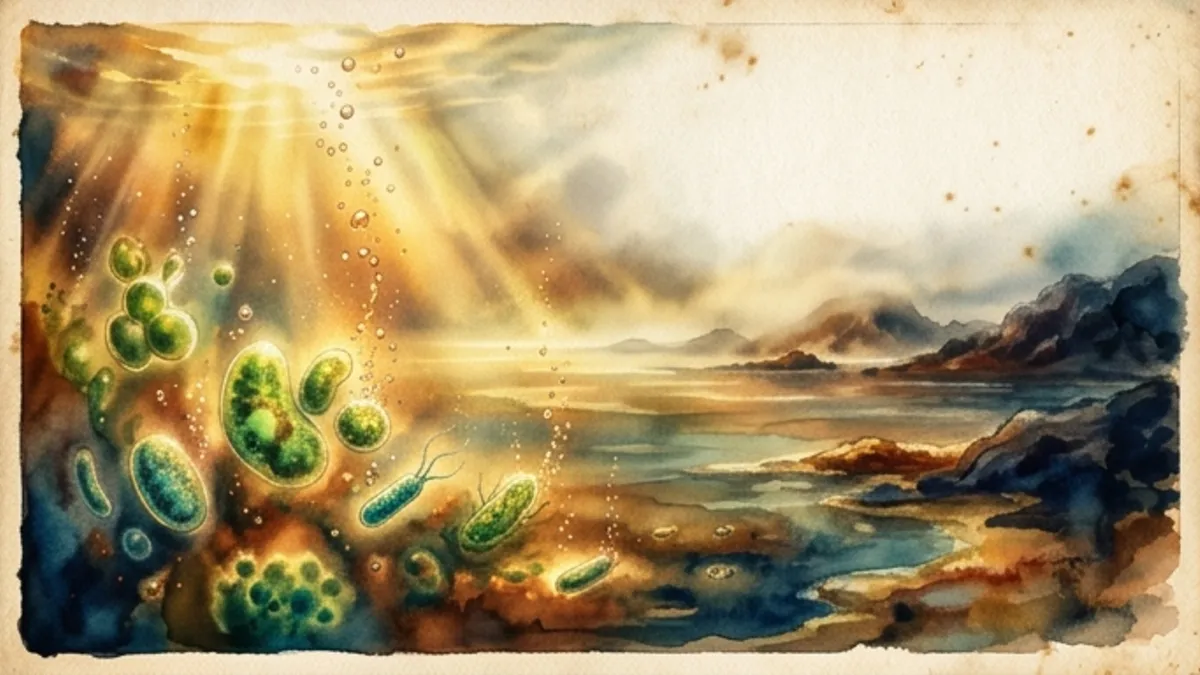
Take one slow breath. It feels ordinary, almost automatic. Yet that breath is older than any human story. Long before animals walked, birds flew or children asked why the sky is blue, tiny green beings were working in the young seas. They had no voice and no plan for the future. Still, they gave Earth the gift that makes your breath possible: oxygen.
When light became breath
In the Second Great Lesson, Earth is not yet a comfortable home. Water, air, rock and sun follow their own laws, and the seas grow heavy with dissolved minerals while the atmosphere is difficult for later life. Then life appears almost invisibly: single cells, early green organisms, algae in the water.
Their wonder is quiet. They take in light. They make food from water and carbon dioxide. While doing so, they release oxygen. A school word suddenly becomes a cosmic gift: the air begins to change. Later, other living beings will breathe, move, grow larger, leave the water and fill the land with sound.
This is why the scene works so powerfully with children. Oxygen is no longer an invisible fact but a trace of ancient work. The algae are not trying to be heroic. They simply do what belongs to them, faithfully and again and again.
Hidden work that prepares the world
Cosmic Education often shifts attention from the spectacular to the essential. Children are surrounded by a culture that notices what is large, fast and loud. The green life of the early seas tells another truth: something can be unseen and still prepare the conditions for everything that follows.
As a supplementary resource for Montessori practice, this impulse invites gratitude without turning it into a lecture. Your breath depends on ancient seas. Your food depends on plants that still turn light into life. Your day rests on countless services you rarely notice. That is a generous way to see the world, and children understand it with their whole body.
Try this today: breathe quietly with a child, then place a green leaf and a glass of water nearby. Ask: who helped with this breath? Let biology become a small practice of thanks.
What hidden work supports your breath today, and what small faithful task could you do so that life around you becomes a little more alive?