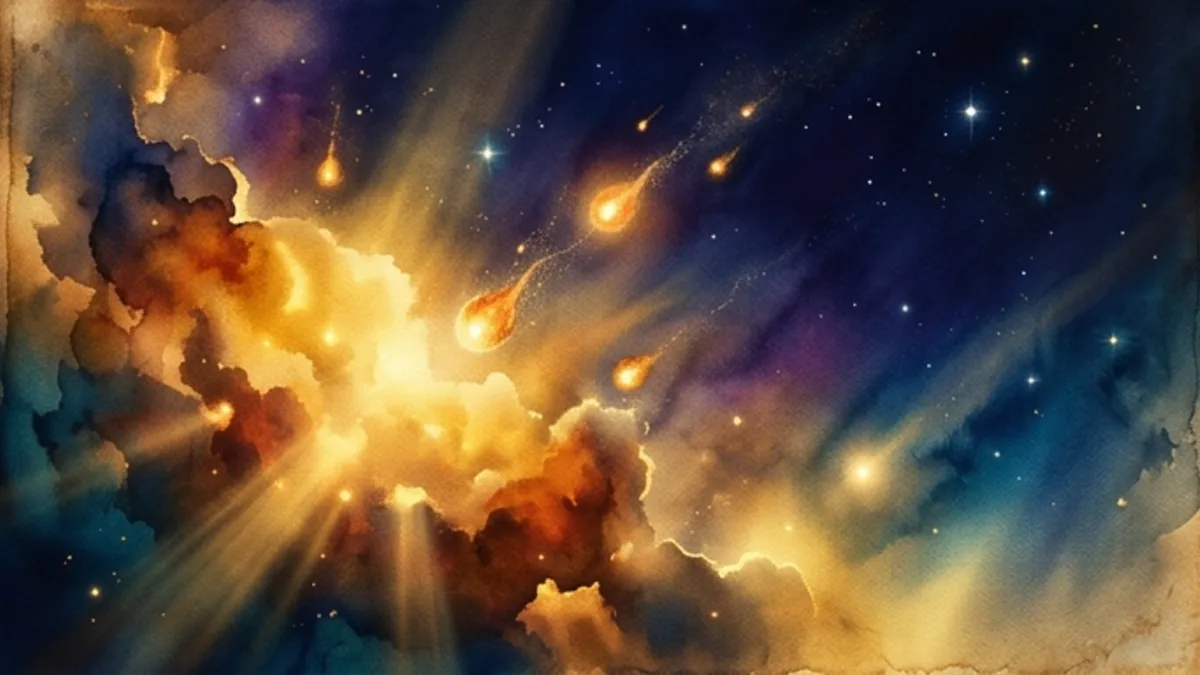
Tonight, if the sky is clear, let one point of light hold your gaze a little longer than usual. Every star up there once had a first instant — a moment when, quite suddenly, it existed. Long before any eye had opened to witness it, light broke open an unimaginable dark. The First Great Lesson carries children all the way back to that beginning, and hands them an image far larger than any single fact could be.
The moment light is born
Anyone who has sat through the First Great Lesson remembers this part. The story does not open with formulas or technical names; it opens with a demand on the imagination — a darkness beside which our blackest night seems bright, a cold beside which ice feels almost warm. And into that emptiness comes light: not a lamp switched on by a careful hand, but an event so vast that everything we will ever know flows out of it.
What makes the telling work is its plainness. It turns the unthinkable — billions of newborn suns — into pictures borrowed from the kitchen and the nursery: scattered droplets, particles dancing, an apple slowly shrinking as it cools. A child needs no astrophysics to feel what is happening. They watch order emerge from chaos, each particle following its own quiet laws, and they see how, out of one glowing cloud, countless stars are flung — and among them, almost too small to notice, our own Sun and our own Earth.
Many storytellers darken the room at this point and light a single flame. The hush that follows is not discipline. It is awe.
Why this moment reaches children
Maria Montessori understood that the elementary-aged child no longer asks only what, but where from and why. The instant the first stars ignite gives those questions somewhere to land. It tells the child: you did not come from nowhere. Everything you are made of was already present in that first light. This is not an astronomy lesson — it is an invitation to see oneself as part of one long, magnificent story.
It also prepares the ground for something every science later rests on: wonder. A child who has once felt that the night sky holds a story does not meet physics and chemistry as a duty, but as the next chapter of an adventure already begun. As a supplementary resource for the Montessori practice, an impulse like this one simply hands you back that opening moment to share.
Try this at home: on the next clear evening, choose a single star together and stay quietly with it for one minute. Then tell your child its light has been travelling toward you both for years — it may have set out before they were even born. That is enough: one star, one minute, one shared question.
When did you last let yourself feel small beneath the night sky — and what might shift for a child who learns that the light they are looking at is older than anyone they have ever met?