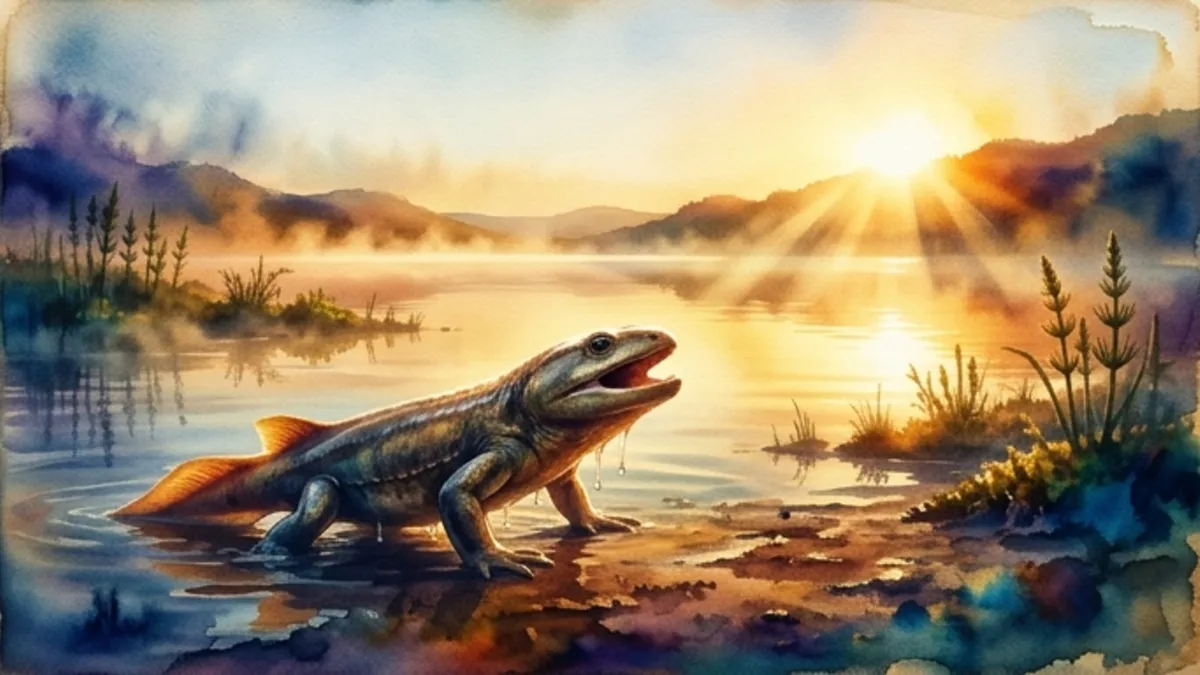
Imagine land before it had animal sound. Rain could strike stone, wind could move across bare ground, thunder could roll over the horizon, but no throat answered. Then life reached the muddy edge between water and air. A small creature breathed, pushed itself forward, and the dry world received something new: a living voice.
The Shoreline as a Threshold
In the Second Great Lesson, the story of life is never still for long. Oceans change, climates shift, habitats shrink and open again. At one point, the shallow waters that had sheltered many animals no longer offered the same safety. Mudflats, drying pools and warm margins became places of risk. For some living beings, the old way was no longer enough.
The amphibian moment gives children a concrete image of adaptation. A body that belonged to water begins to meet air. Fins become stronger supports. Moist skin remains necessary, yet lungs make a new kind of life possible. The creature is not leaving its past behind completely; it carries the water with it in its needs, its eggs, its skin. But it also enters a new world.
And with air comes sound. A living call over land is more than noise. It is a sign that life has crossed a boundary and found another way to be present. For the child, this moment is powerful because it can be heard in imagination. The timeline is no longer only a sequence of pictures. It becomes an acoustic history: before and after the first voice on land.
Listening as Cosmic Gratitude
Montessori education often begins with wonder, but wonder does not stay vague. It becomes attention. When a child hears frogs after rain or crickets at dusk, those sounds can be connected to a very ancient transition. The evening chorus is not decoration. It is a living echo of bodies that learned to breathe air, move across mud and answer the world aloud.
As a supplementary resource for Montessori practice, this impulse also invites adults to listen differently to the child. Voice is not only speech. It is courage, presence, the first attempt to be heard in a new environment. A child who asks, protests, sings or whispers may be practicing a threshold of their own.
The amphibians teach a patient truth: change does not always arrive with confidence. Sometimes it comes damp, awkward and half-ready, one breath at a time. Yet that first breath can open a whole landscape.
Try this today: step outside near evening, after rain if possible, and listen for one minute without naming anything. Then choose one sound and wonder together: who is making it, what does it need, and how long has such a voice belonged to Earth?
Which small voice in your child's world might need more quiet around it, so that you can really hear what is beginning to emerge?