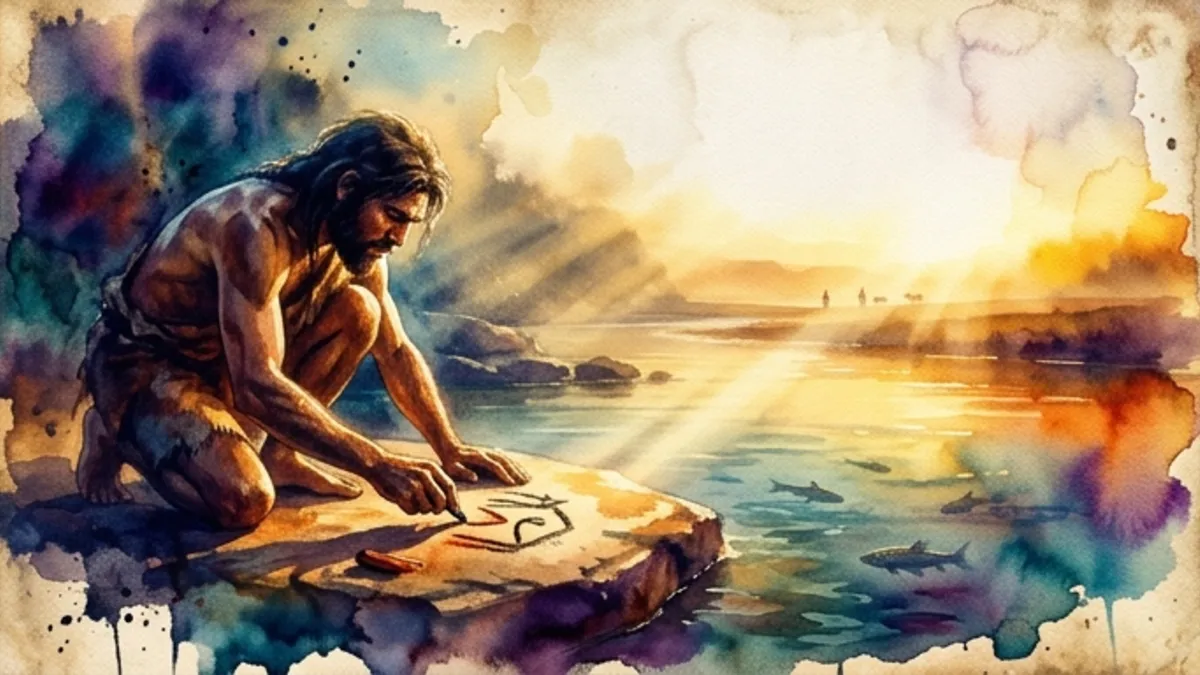
A voice is immediate and alive, but it vanishes. It reaches the people nearby, warms the air for a moment, and is gone. The Fourth Great Lesson invites us to pause at a quieter wonder: the instant when a human being senses that a message can remain. A mark on stone can wait. A drawing can speak to someone who is not there yet.
A message for the absent
Before alphabets, before books, before any classroom page, human beings already needed one another. They found food, shelter, water, danger, paths and gifts in the world around them. When the group was together, gesture and sound could do enough. A hand could point. A call could gather. A face could warn or welcome.
Then comes the simple difficulty that makes writing necessary: what if the others are somewhere else? Perhaps someone has found fish in a stream, a safe path, a tree heavy with fruit, or a place to avoid. The experience matters, but the intended listener is absent. So the hand begins to leave something behind: a line, a picture, a sign, a trace. It is not yet writing in the later sense, but it already carries the seed of writing. Meaning is placed outside the body.
Children understand this without much explanation. They leave drawings on a table, labels beside treasures, chalk marks on a path, folded notes under a pillow. They know the delight of finding that a mark has been understood. In this moment the Great Lesson does not make writing smaller by turning it into a skill. It makes writing larger by returning it to relationship.
Writing begins with care
As a supplementary resource for Montessori practice, this impulse asks us to begin early writing with purpose. A child does not first need a perfect line in order to have something worth saying. The human story of writing begins because someone cared enough to make a thought available for another person.
When adults receive children's first marks with this awareness, correction can find its proper place. Accuracy will grow. Hand control will refine. Spelling will become clearer. But beneath all that is the essential discovery: a sign can hold meaning until another person arrives.
Try this today: invite a child to leave a wordless message for someone: three drawn clues, a trail of natural objects, or a picture beside a real object. When it is found, talk about what was understood and what needed more clarity.
What message could you leave today that would still be gentle, useful or grateful when someone discovers it later?