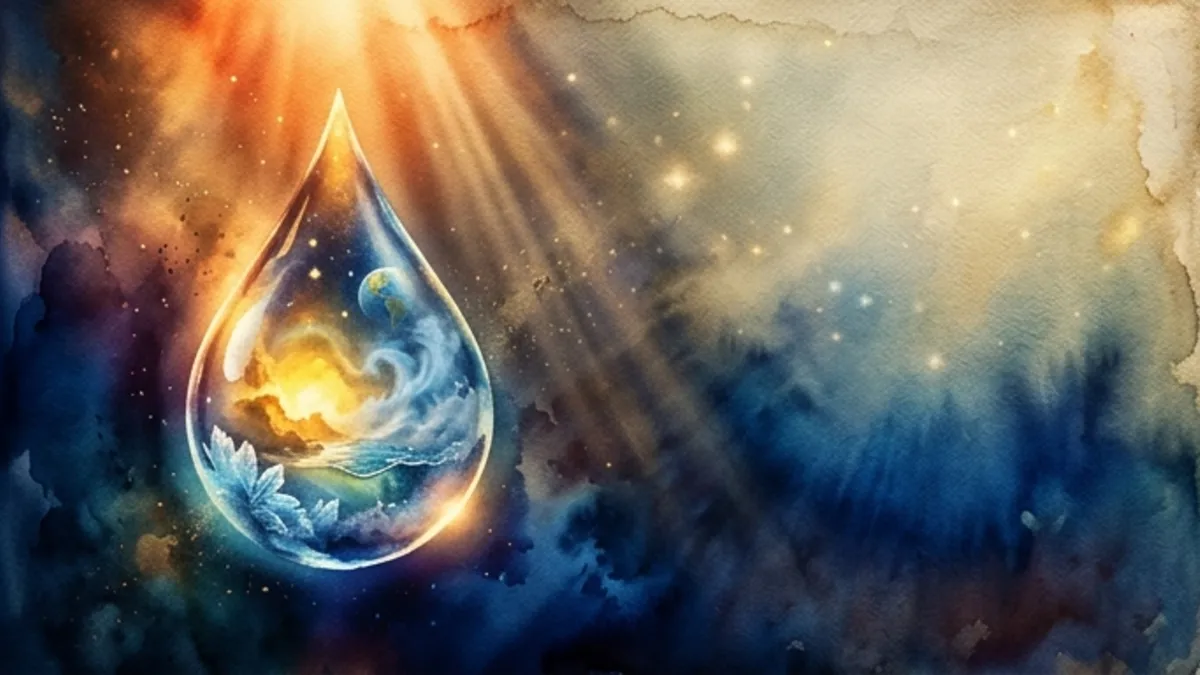
Hold one drop of water on your fingertip and look at it as if it were a tiny window. Inside that small brightness lives a memory of mist, rain, ice, sea and cloud. The same substance can disappear, flow, freeze and return. For a child, this is not a small fact. It is a doorway into the way the Earth became a home.
When matter changes its form
In the First Great Lesson, the universe is not introduced as a list of terms. It is a drama of heat, cold, movement and order. The young Earth slowly cools. Matter that once moved freely as gas can become liquid; liquid can harden into solid form. Rock, water and air begin to appear not as isolated things, but as matter responding to conditions.
Water makes this immense idea close enough to touch. A child sees steam rise from a warm cup, droplets gather on a cold pane, an ice cube soften in the hand. Suddenly the beginning of the Earth is not only far away in geological time. It is present in the kitchen, in the garden, on the window in winter.
This is why the drop matters. It lets the child move between the cosmic and the intimate. The story stretches imagination toward the early Earth, then places the same principle in the child's own hand: warmth changes movement, cold changes form, and transformation is part of the world's deep order.
A small teacher of wonder
As a supplementary resource for Montessori practice, this impulse invites the adult to protect a slower kind of attention. We do not need to explain every detail at once. We can first watch: the shine of ice, the breath of steam, the coolness left by a drop on skin. From such observation, scientific language arrives with meaning.
The three states of water become more than vocabulary. They become an experience of trust. Nothing is wasted; it changes form. The world is active, lawful and alive with processes. A child who has felt that may later learn density, temperature and evaporation with a different heart.
Try this today: place one ice cube in a small bowl and set a glass of warm water beside it. Watch quietly first. Where do droplets appear? When does steam rise? Afterward, name the three forms: ice, water, vapour.
Where might you meet transformation today: in a cloud, a puddle, a melting cube of ice, a breath on the window? How could you help a child see a piece of Earth's history there?