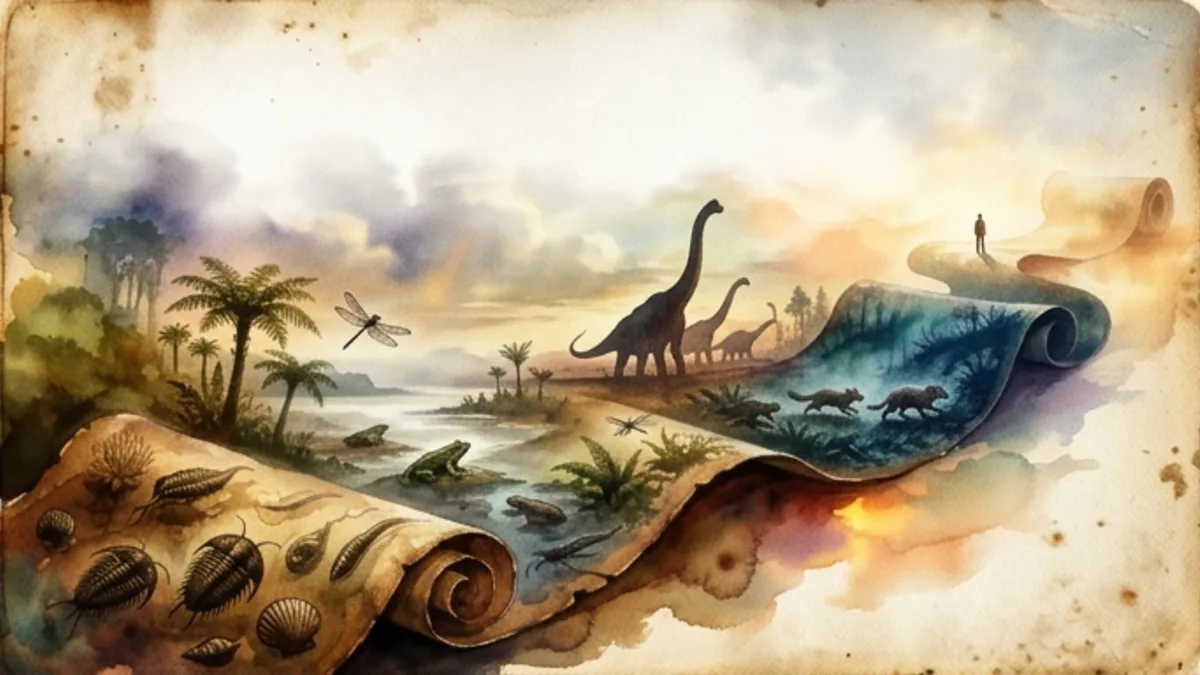
Picture a paper ribbon rolled out across an entire classroom floor — and still too short to hold everything that has ever lived on Earth. At its very far end, no wider than a fingernail, stands one tiny figure: a human being. Everything before that mark — endless metres of shells, ferns, giant reptiles and quiet creatures of the water — had to happen first. Once a child has stood at the near end of such a ribbon and walked all the way to the far tip, time itself never looks quite the same again.
A ribbon longer than anyone can imagine
In the Second Great Lesson, after life first appears, comes a material many children never forget: the Timeline of Life. It is not shown all at once but unrolled slowly, section by section, while the guide tells what happened in each stretch. At the beginning there is only water, and in that water an astonishing crowd of small lives stirs — amoebas, sponges, sea anemones waving delicate arms to draw in floating food, and the trilobites, which for a very long stretch of the ribbon are the undisputed rulers of the seas.
Roll by roll, the picture changes. Plants creep cautiously onto land, cephalopods grow several metres long, sea lilies sway gently on the ocean floor. Then the first fish with a proper backbone appear, forests of horsetail plants rise into being, and at some point a completely new sound is heard on land for the very first time — the first amphibians have left the water, though not entirely. Reptiles solve that last problem with a hard-shelled egg. And then, across a long stretch of the ribbon, the dinosaurs take over: enormous, loud, unchallenged — until small, unassuming creatures with feathers or fur manage to survive in the colder corners of the world the giants never bothered to visit.
What makes this part of the story so striking is the pace it takes on once the ribbon is actually unrolled. The early ages barely need two or three steps to cross — and an unimaginable stretch of time has already passed. Only near the very end does everything crowd together: forests, reptiles, towering lizards, small mammals, all packed into the last few centimetres. Only after all these rolls, after millions of years no child can truly hold in their mind, does a creature without sharp teeth, without armour, without warm fur appear at the ribbon's furthest edge. What it has instead: a much larger brain, the ability to imagine, and the ability to love — not only its own young, but beings it has never met. The human being does not arrive as the goal of the story, but as its youngest, most fragile moment.
Time you can walk with your own feet
What gives this ribbon its power is its sheer length. Children cannot really grasp a number like "500 million years ago" — but they can walk along a paper strip and feel, in their own legs, how long the road to the human being truly was. That bodily experience of time is something quite different from a spoken explanation. It produces awe without fear, and it gently puts a child's own importance into proportion, without making them feel small.
There is a double gift hidden in this. First, a child learns that they belong to a story that began long before them and will not end with them. Second, gratitude grows for all the quiet preparatory work — for trilobites, ferns and amphibians that knew nothing of any human being and yet, without meaning to, prepared the stage. Once a child has felt this, they often carry a new kind of patience with them: some things really do take an enormous amount of time, and that is not a flaw in the world's design but its very nature. As a supplementary resource for Montessori practice, this impulse invites us simply to marvel together at how long a road was walked before any of us arrived.
Try this today: roll out a long strip of paper or an old roll of wallpaper and divide it roughly into stretches — ocean, land, forests, dinosaurs, mammals, humans. Let your child guess first how large the very last stretch, the one for humans, might be — then compare that guess with the real, startlingly narrow strip.
If you think of the long ribbon of life, where would you most like to stop and look longer? And what changes in you when you know how narrow the stretch reserved for you truly is?