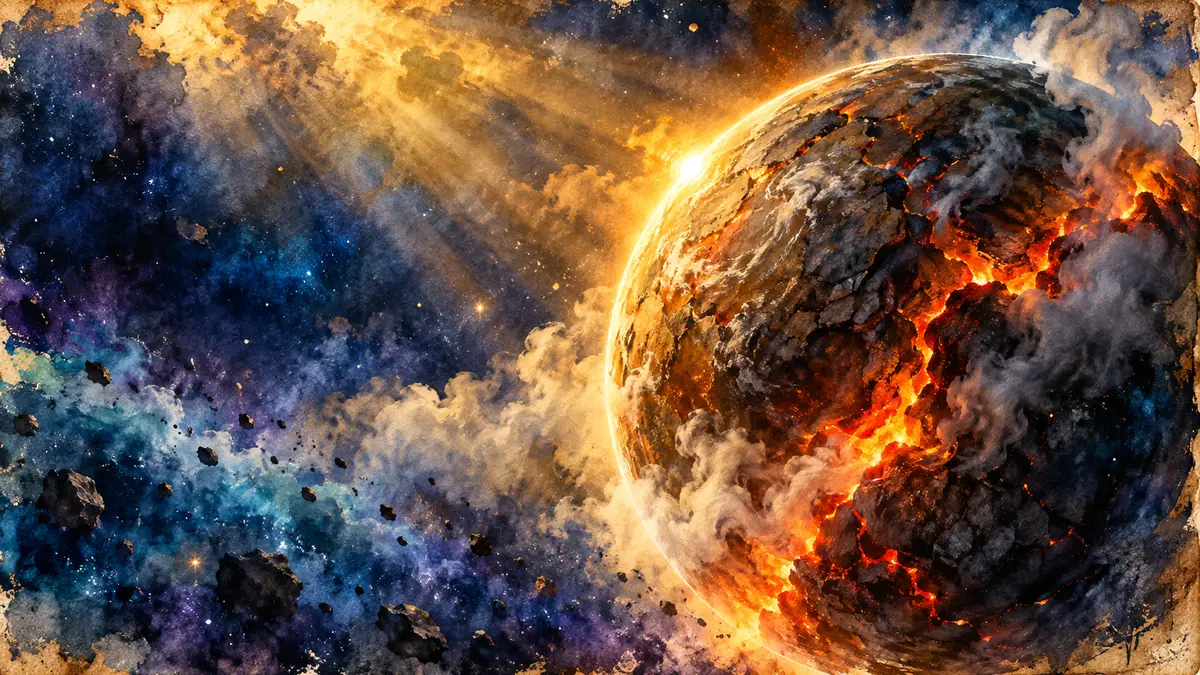
Imagine returning to the same place on the young Earth every morning. There is no morning in any familiar sense: no birds, no leaves, no path to remember. The world is hot, its surface unsettled. You wait a day, then a year, then a lifetime. You might still miss the change that matters. Heat is leaving, matter is responding, and a future ground is becoming possible. The First Great Lesson asks us to picture an event too slow for a witness. Its surprising hero is duration. Nothing can hurry a planet into being a home.
What changes while nobody watches?
When the story reaches the early Earth, children are far from the blue globe on a classroom shelf. The planet formed amid collisions and intense heat. Different regions did not follow one tidy schedule. Material at the outside could lose heat and become solid while the interior remained hot. Impacts and activity within the Earth could disturb surfaces that had already formed. We can tell this clearly without claiming to know the exact appearance of every ancient day.
Cooling sounds modest beside eruptions and collisions. Yet temperature helps determine what matter can do. As heat leaves a molten substance, its particles move differently and solid rock can form. Later conditions allow water to remain liquid in places. Each change opens a possibility; none by itself produces a forest. Children often want to jump straight from fire to flowers. Leave a pause between those pictures. Ask what has to be possible before the next picture can exist.
The word “gradually” deserves attention. In ordinary life a bowl of soup cools before lunch is over. A stone warmed by sunlight feels different after dusk. Those experiences give children a starting point, but Earth’s history is not a giant bowl of soup. Planetary processes unfold on scales of distance, time, pressure and energy that our kitchen observations cannot reproduce. We use the small event as a question, not as a perfect model.
Evidence from rocks and scientific measurements helps us reconstruct parts of that remote past. It does not give us a film we can replay. A useful storyteller can say “scientists infer” and “we still investigate” without dimming a child’s wonder. Indeed, the uncertainty is part of the invitation: imagine how much patient work it takes to learn about a time from which almost no original surface remains.
Learning to notice a slow beginning
Children live among changes that adults overlook. A seed has not visibly moved since yesterday, yet it is taking up water. A damp cloth seems the same until it dries. A mark on the doorframe seems fixed until two dates stand beside it. Such observations do not compress billions of years into a week. They help us practise a more honest habit: return, compare and ask what happened between visits.
Cosmic education offers more than a sequence of spectacular scenes. It gives the child a place within a long story. The solid ground beneath our feet is the result of processes that began before there were feet at all. Gratitude here need not be a speech. It can begin when a child holds a stone, feels its cool weight, and asks how something so stable acquired its form.
Patience is often presented as waiting quietly for a reward. Here it is active attention. We record a first observation, resist the urge to supply the conclusion, and make room for a second one. The adult need not know every answer. The important move is to let the child discover that “nothing happened” may mean only “I have not looked closely enough, or waited long enough”.
Try a cooling diary: place equal amounts of comfortably warm water in two sturdy cups. Wrap one in a cloth and leave the other uncovered. With an appropriate thermometer, let your child record both temperatures at the start and every ten minutes. Draw the points on paper and talk about what changed. The cloth may alter the rate at which heat is lost. State the limit plainly: cups cannot recreate the chemistry, scale or long history of the early Earth. They make a slow change visible enough to ask better questions.
Afterward, return to the story’s enormous scale. Our chart occupies part of an afternoon; the planet’s transformation occupied spans we cannot watch. The chart is valuable precisely because it makes us feel the difference. We can notice a trend without pretending that we have seen the whole journey. That is a small, sturdy form of scientific humility.
What nearby change would disappear from your attention if you looked only once? Is there something you and a child could observe today, then revisit in a few days, leaving room for a surprise instead of deciding in advance what the ending must be?