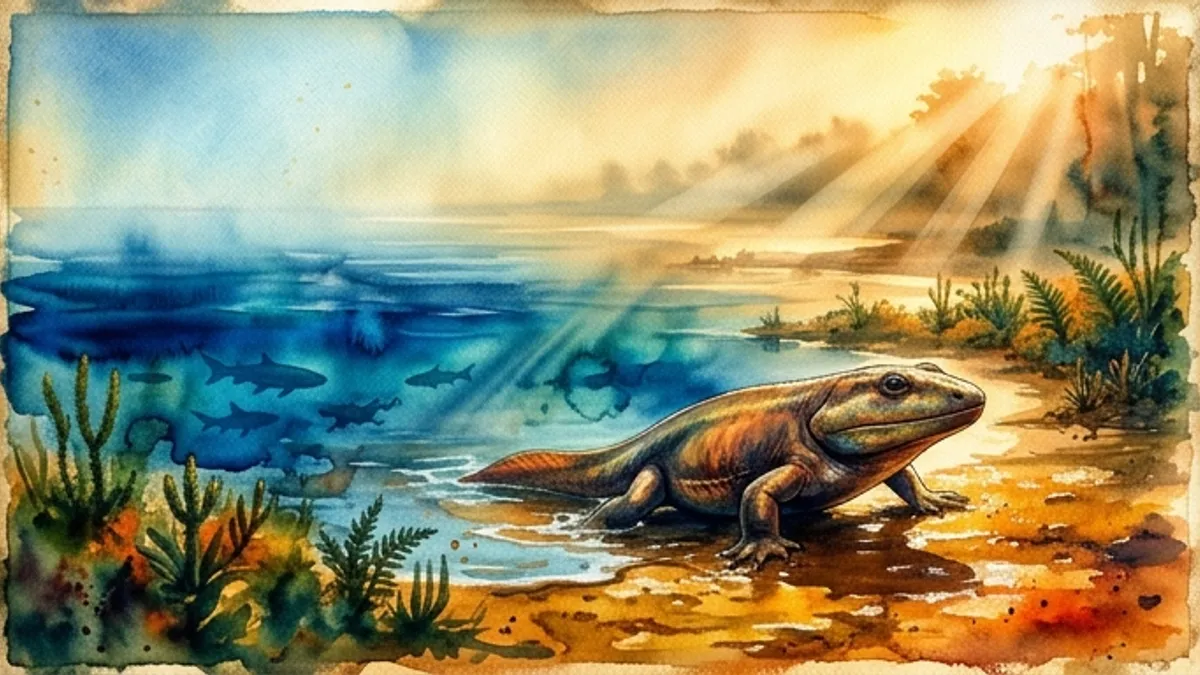
A shoreline looks ordinary only because we were born on the landward side of it. For a body shaped by water, the edge of a pool changes every rule at once. Buoyancy fades. Weight presses down. Skin begins to dry. Sound, light and scent arrive differently. More than 360 million years ago, some vertebrate relatives lived precisely in this unsettled margin. Their story was not a heroic leap out of the sea. It was a long conversation between bodies and conditions, carried through generations. The shore became a workshop where old abilities met new demands—and where another world slowly became possible.
The place where weight returned
In the Second Great Lesson, the Timeline of Life keeps returning our attention to water. For most of the story, the seas are the crowded stage while the land waits almost empty. Plants and arthropods reached the continents before vertebrates did, altering soils and habitats. Then, during the late Devonian, shallow waterways held animals related to the first four-limbed vertebrates. Some had lungs or lung-like organs as well as gills. Some possessed fleshy fins with bones arranged in ways that could help them brace against mud or vegetation. These traits were useful in water before they supported longer excursions onto exposed ground.
Fossils do not show a tidy parade from fish to frog. They reveal a branching mosaic. A mobile neck appears in one form, stronger ribs in another, digits in animals that may still have spent almost all their time in water. Natural selection did not work toward a picture waiting in the future. Variations that helped organisms feed, breathe, escape danger or reproduce in particular environments were more likely to continue. Over immense spans of time, a set of possibilities accumulated.
On land, every solution uncovered another question. A limb could push against a firm surface, but the skeleton also had to support the body without the water carrying it. Air held abundant oxygen, but delicate respiratory surfaces needed protection. Eyes and ears met a medium with different physical properties. Moist skin lost water. Eggs and young often still required pools or wetlands. Early tetrapods therefore did not simply abandon one home for another. Many lived across a threshold, returning to water even as they explored its margins.
This is a powerful pause in the telling. Children can imagine a quiet bank acquiring movement, marks and eventually calls, yet the scientific picture keeps the wonder honest: there was no first animal that decided to conquer the land. There were populations, changing landscapes and countless small inheritances. What looks like one bold step from far away was made from millions of modest ones.
Courage without a finish line
We often praise change by celebrating the person who leaves safety behind. The history of the shoreline offers a gentler image. The familiar environment was not a mistake, and returning to it was not failure. Water continued to shelter, feed and receive new life. The margin mattered because it allowed two sets of conditions to overlap. Adaptation grew there gradually, supported by what had come before.
Cosmic education can hold this complexity without draining away the drama. A child discovers that novelty is relational. Limbs mattered because there was a surface to press against; breathing air mattered because plants and microbes had transformed the atmosphere; life on shore depended on the long labour of earlier organisms and geological change. No creature starts from nothing. Even our arms, wrists, lungs and thirst carry traces of an aquatic inheritance.
This perspective changes how we accompany learning. When a child stands before a new skill, “be brave” may be too large and too lonely an instruction. A useful transition needs footholds, time, repeated attempts and permission to move back toward what is known. The goal is not to remove all uncertainty. It is to shape a shoreline where experimentation can happen without turning one difficult moment into a verdict about the learner.
Try this with a group: place a blue cloth beside a brown one. At their meeting line, set four cards: “breathe”, “carry weight”, “keep moisture” and “protect the next generation”. Invite children to suggest traits or behaviours that might help with each challenge. Then ask which could already be useful in shallow water, which mattered more on exposed ground, and which still tied an animal to a pool. Do not arrange the answers as a ladder. Build a web of connected possibilities instead.
Where are you—or a child beside you—living at a shoreline between the known and the new? What small foothold, safe return or repeated attempt could make the next movement possible without demanding one magnificent leap?