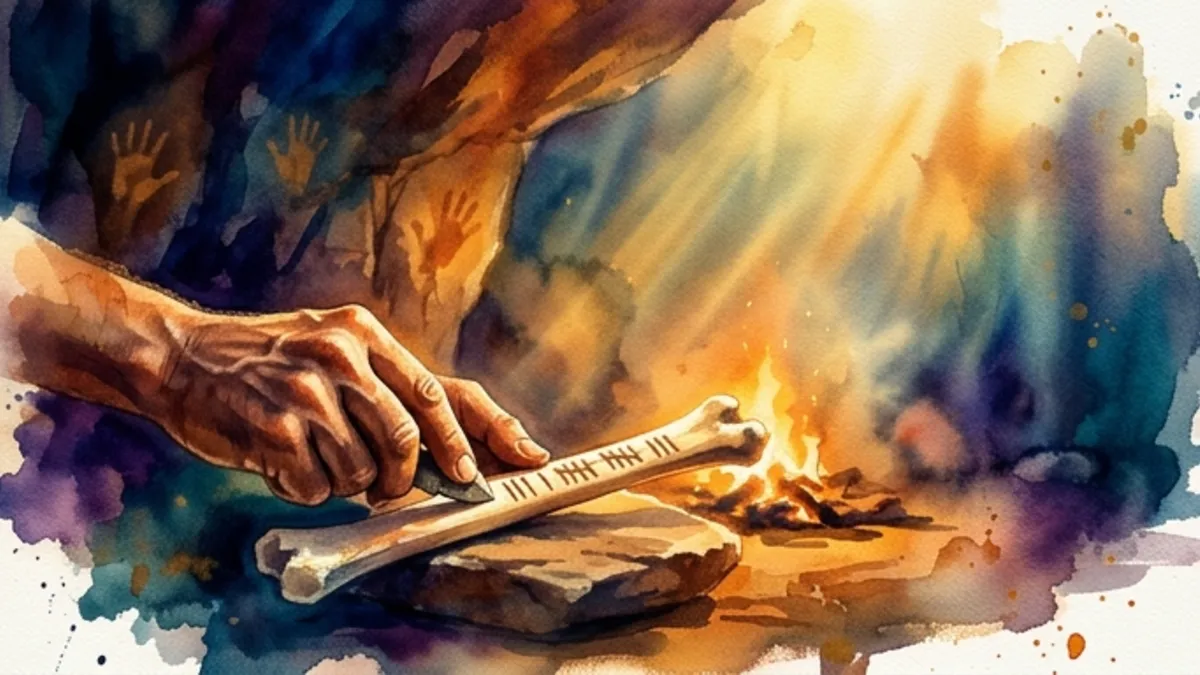
Somewhere in southern Africa, roughly forty-two thousand years ago, a person sat down with a sharp flake of stone and cut a notch into a piece of bone. Then another. Then another. We will never know that person's name, or the sound of their voice, or what they ate that day. All of it has blown away. But the notches are still here. Twenty-nine fine strokes in a fragment of bone smaller than your hand — older than any village, any city, any written word. It is the oldest surviving mathematical object human beings have made. And someone cut it by hand.
A mark meant to last
The Fifth Great Lesson takes children back to the beginning of our numbers — to a time when people already had a sharp sense of quantity but no digits to write it down with. Between counting and writing, though, lies a step that is easy to miss entirely: the moment someone decided that a quantity should not merely be shown, but kept. For tomorrow. For next month. For someone not yet born.
Showing is fleeting. A raised hand comes down again. Pebbles laid out on the ground are kicked aside or scattered by the wind. Anyone who wanted to hold on to a number across many nights needed something harder, something that would not perish. Someone found it: bone.
The object in question comes from the Lebombo mountains in southern Africa. It is a slim piece cut from the fibula of a baboon, barely eight centimetres long, carrying twenty-nine carefully incised notches. Radiocarbon measurements place it at roughly forty-two thousand years old. Twenty-nine happens to sit very close to the length of a lunar cycle, so it may be that someone here was counting the nights until the moon came round again. We cannot know that for certain. What we can say for certain is that these marks are no accident. They are even, deliberate, counted.
And more is hidden in a notch than first appears. One stroke for one animal, one stroke for one night: each sign stands for exactly one thing — not two, and not half. This one-to-one correspondence is the silent heart of all mathematics, and it had to be discovered. The person at the bone was separating quantity from the things themselves for the very first time. The nights had passed; the animals had long since moved on. What remained was their number alone, detached, standing on its own, cut into bone. That is the instant at which perception becomes number.
Numbers had an inventor
For a great many children, numbers feel like the weather: simply there, arriving from outside, not open to negotiation. A child who is shaky at arithmetic soon comes to experience mathematics as an alien system with authority over them. The bone overturns that feeling. It shows that numbers did not fall out of the sky. They were made — by somebody with hands, with a genuine need, with an idea.
And that first stroke is not just any beginning. It is the ancestor of everything that followed: of the tally chalked on a kitchen board, of the Sumerians' marks pressed into damp clay, of the figure printed on a supermarket receipt. Forty thousand years lie between the notch in the bone and the number in a school exercise book — and yet it is the same gesture: holding on to something that would otherwise slip away.
Cosmic education takes the view that children do not stand at the end of this development but travel through it once more themselves. A child threading beads into a row, sorting conkers, or marking a cross on the calendar for each passing day repeats in a few years what humanity needed millennia to work out. The child is not inventing number afresh — but they walk the same road a second time, with the same hands, out of the same need. Once you know that, you watch a counting child rather differently. And as a supplementary resource for the Montessori practice, this shift does something quiet and lasting: a child who grasps that number is an invention is allowed to trust themselves with it.
Try this today: take a stick, or a strip of stiff paper. On every evening you can see the moon, make one single mark together — no more than that. After about four weeks there will be roughly twenty-nine of them. Don't throw the strip away; put it somewhere good. Your child is then holding the same thing in their hands as that person forty-two thousand years ago. The keeping is not an afterthought here — it is the whole point.
What among the things you count today would truly be worth holding on to — not in your phone, but in something that stays? And what would a person forty thousand years from now make of your marks, if they ever found them?