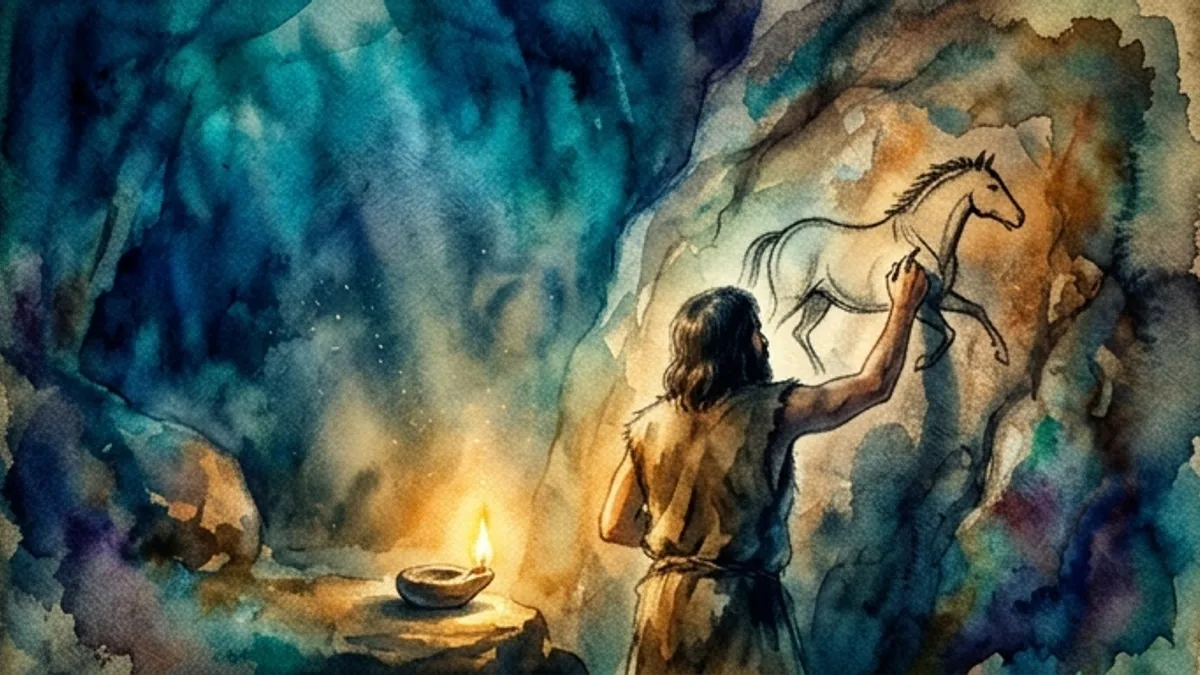
The animal has gone, but someone can still see it. Perhaps the turn of its head stayed in a person's memory, or the curve of its back returned while they looked at a stone wall. We cannot recover that private moment. We can stand before an ancient drawing and notice its remarkable outcome: an absent creature has become visible. In the Third Great Lesson, this is a place worth lingering. A human hand does more than make things useful. It can bring something remembered, imagined or deeply significant into a space that other people can share.
There is a person behind the line
When children hear about early human beings, practical questions often come first. Where did they sleep? How did they find food? Those questions matter. Yet a painted animal interrupts the idea that the distant past contained only a struggle to stay alive. Here is something that calls for another kind of attention. A person selected a surface, worked with a material and produced a form. We may not know its purpose, but we can recognise that making it involved decisions.
The Third Great Lesson offers the hand, the mind and the heart as a way of considering human possibilities. Art lets us explore their relationship without treating the three gifts as separate compartments. A remembered shape guides a movement; the surface changes what the hand can do; another movement answers that discovery. Thought and action keep meeting. Looking at the result today, we add our own attention to a very long human story.
It helps to resist the temptation to explain every image. A horse on a cave wall is not a captioned photograph. We cannot simply announce that its maker wanted a successful hunt, taught a lesson or signed a message for the future. Different works may have served different purposes. The archaeological account of Chauvet cave describes many powerful animals that were generally not hunted. The images invite inquiry rather than one convenient answer.
Nor does the earliest surviving object identify the first artistic act. A mark on skin, a design in soil or a shaped piece of perishable material might leave no trace for us to find. Survival filters the evidence. This is an excellent distinction to offer a child: what remains is real, but it is not everything that happened. We can wonder about missing possibilities while keeping them separate from things we actually observe. Our imagined artist is a doorway into thought, not a recovered individual.
Give the picture time to speak
A child offers you a drawing. Before you decide what it represents, there is a small opportunity to practise the same respect. Look for a decision: a crowded corner, a repeated mark, an unusually large shape. You need not guess a hidden emotion or turn the picture into a test. Simply making room for the child's account can change the conversation. They may want to explain it, or they may be content that you looked carefully.
This is one practical meaning of gratitude within cosmic education. We receive a world full of human efforts whose makers are often unknown to us. Some solved difficulties; others created forms that still move us. Their value does not depend on our ability to attach a name. An ancient drawing can help loosen the habit of measuring every human achievement against the present. People with different tools were capable of great attention and skill. Distance in time is not a measure of intelligence.
It also makes space for uncertainty in learning. You can say what is visible, distinguish an interpretation and leave a question open. Children then encounter knowledge as something built carefully, rather than a performance in which adults always know the answer. The drawing becomes a meeting point between curiosity and restraint. We are free to imagine, and responsible for noticing when we are imagining. Both capacities belong in a thoughtful encounter with the past.
Try this together: Offer rough paper and a few wax crayons. Invite the child to remember an animal they have watched and make a drawing from that memory, without a model to copy. Afterwards, let them choose one part for you to notice. Describe its visible qualities before offering an interpretation: a long curve, a light mark, a place where lines meet. Let the child decide whether to explain more and whether to keep or share the picture. This is an exploration of making a remembered image visible, not a claim to reproduce the intentions of prehistoric artists.
What might you notice in someone's picture if you gave it a little more time before naming what you saw? Carry that question into your next encounter with a child's drawing or an ancient image. There may be a human decision waiting where you first saw only a line.