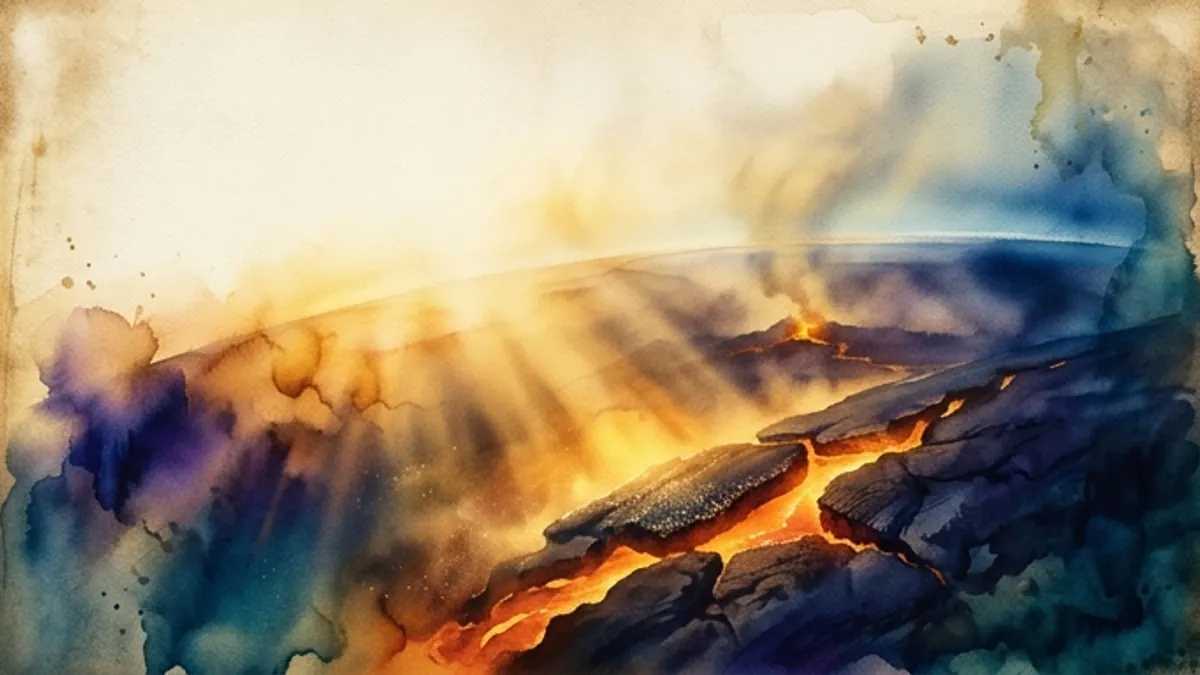
Pick up a piece of dark basalt and turn it in the light. It feels settled, almost stubbornly solid. Yet the material in your hand once moved as molten rock. The surprise is not simply that Earth was hot. It is that cooling made a boundary where there had been restless liquid material: a first, fragile outside. Calling it a “skin” lets a child picture the change, as long as we remember that this skin was stone, repeatedly cracked, buried and remade. A quiet rock can therefore hold the memory of motion.
The moment the outside began to hold
In the First Great Lesson, the young Earth arrives as a place of extraordinary heat. Collisions during its formation, the movement of dense materials towards the interior and radioactive decay all contributed energy. We need not turn this into the picture of one unbroken ocean of lava covering every place for one exact span of time. The early planet changed violently, and evidence from so remote a past is incomplete. The dependable idea is simpler: much rocky material was hot enough to melt, while heat steadily escaped towards space.
At the outside, cooling mattered first. In molten silicate material, atoms can move past one another. As temperature falls, minerals begin to crystallise and lock into solid arrangements. This is the making of igneous rock. Below the surface, molten rock is called magma. Only when it emerges is it called lava. The distinction is small enough to remember and useful enough to keep: the name tells us where the molten material is.
Cooling speed leaves a trace. Magma that remains insulated underground may cool slowly, allowing larger crystals time to grow. Lava exposed at the surface loses heat much faster, so its crystals are often too small to see easily. If cooling is extremely rapid, a glassy texture can form instead. Basalt and obsidian are therefore not merely “black stones”. Their textures are clues to different cooling histories.
The earliest crust was not a finished lid placed neatly over the planet. Hot material could break through it; impacts and internal activity could melt or recycle it. “Earth grew a skin” names a transition, not a single birthday. Still, every interval of solid ground changed what was possible. A surface could support hollows, receive material and, as conditions allowed, provide places where liquid water might persist. Much later, life would need that kind of stage.
A boundary can be a beginning
Children often hear cooling as an ending: the fire goes out, movement stops, the exciting part is over. Here cooling is creative. It does not add a new substance; it changes how the same material can behave. Flowing rock becomes a place. The outside becomes different from the inside. A boundary appears, and with it come new possibilities.
This is a gentle way into geological thinking. A rock is not an object without a story. Grain size, shine, bubbles and layers invite hypotheses: Did material cool quickly or slowly? Did gas escape? Was this rock changed later? The aim is not to make a child guess a specimen’s name on command. It is to practise looking for evidence while remaining comfortable with “perhaps” and “I need another clue”. That habit protects wonder from becoming make-believe.
The skin image also deserves one honest limit. Earth’s crust is not biological skin, and the planet did not simply cool, shrink and wrinkle into today’s mountains. Plate movement, volcanism, erosion and many other processes have continually rebuilt the surface. A metaphor opens the door; observation and careful language keep us from locking ourselves inside it.
Try a cooling table: place a known piece of coarse-grained granite beside fine-grained basalt, and add obsidian if you have a safe, labelled sample. Use a hand lens. Let your child describe only what is visible before offering the cooling stories. For a second observation, an adult may melt a little beeswax and pour it into a shallow heatproof dish, keeping hot wax and equipment entirely in adult hands. Watch the surface film become firm while material beneath can still move. Say clearly that wax models only a phase change and faster cooling at an exposed surface; it does not model Earth’s composition, scale, crustal structure or geological history. Once everything is cool, lift the wax edge and ask what the model helped you notice — and what it could not show.
If the first solid ground was repeatedly broken and remade, what does it mean to call it a beginning? Where else in nature does a temporary boundary create the conditions for something entirely new?