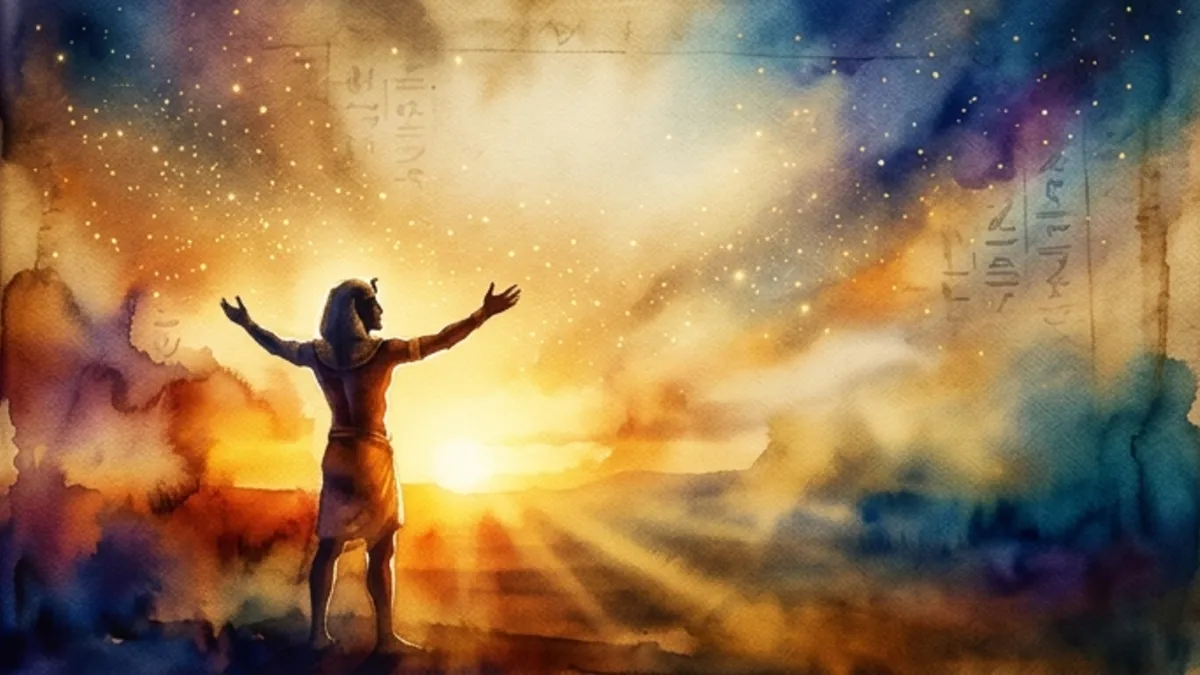
Picture a number so large it slips out of your hands. You cannot hold it on your fingers, you cannot lay it out in pebbles, you cannot cut it into a stick. A million. More than four thousand years ago, people along the Nile stood before exactly this edge — and answered it in a way no one would expect. They did not invent a new stroke or a clever dot. They reached for themselves: a human being, arms flung wide, as if to gather the whole sky.
A person who embraces the sky
The Fifth Great Lesson follows numbers across enormous stretches of time. Children hear how the earliest people counted on their fingers, cut notches into wood, set down pebbles and tied knots in cords. Then they meet the Egyptians, who did not write numbers as dry marks but as small pictures — hieroglyphs. For ten, for a hundred, for a thousand, each had its own sign. Yet the most beautiful one they kept for the greatest quantity of all: for a million they drew a human figure with both arms thrown wide open.
When you share this moment with children, almost the same thing happens every time. They copy the gesture. Arms up, hands spread, eyes wide — it cannot get any bigger. Suddenly a number that no one can truly picture is close and alive. It no longer hides inside a foreign symbol; it lives in their own body.
What the Egyptians were saying, even the youngest can feel: this number is so vast that no stroke, no dot, no single word can hold it. Only a gesture will do — the gesture of a person who marvels and longs to embrace everything that cannot be counted.
Why a gesture says more than a symbol
Maria Montessori knew that children meet the world first through the body, not through abstractions. That is exactly why this moment reaches so deep. The Egyptians did not hide the largest thing they could imagine inside a cold mark — they opened it up. Their million is not a dry note but an invitation to wonder.
This is the real message of the Fifth Great Lesson. Numbers were not handed down from desks and textbooks. They grew from a deeply human need: to know, to put in order, and to stand in awe of what can barely be grasped. When a child understands that even the great million once began as a pair of open arms, mathematics loses its sharpness and its fear. It becomes a story of people brave enough to name the immeasurable.
As a supplementary resource for Montessori practice, this impulse invites us to let the million be felt long before it must be calculated.
Try this today: ask your child, “How big is a million?” Then do as the Egyptians did — spread your arms as wide as they will go. Together, gather things there could be a million of: grains of sand on a beach, stars in the night sky, drops in the sea. What matters is not the answer but the shared wonder at a number larger than any picture.
Which number feels so large to you that you could only show it with open arms — and when did you last marvel at something you could no longer count?