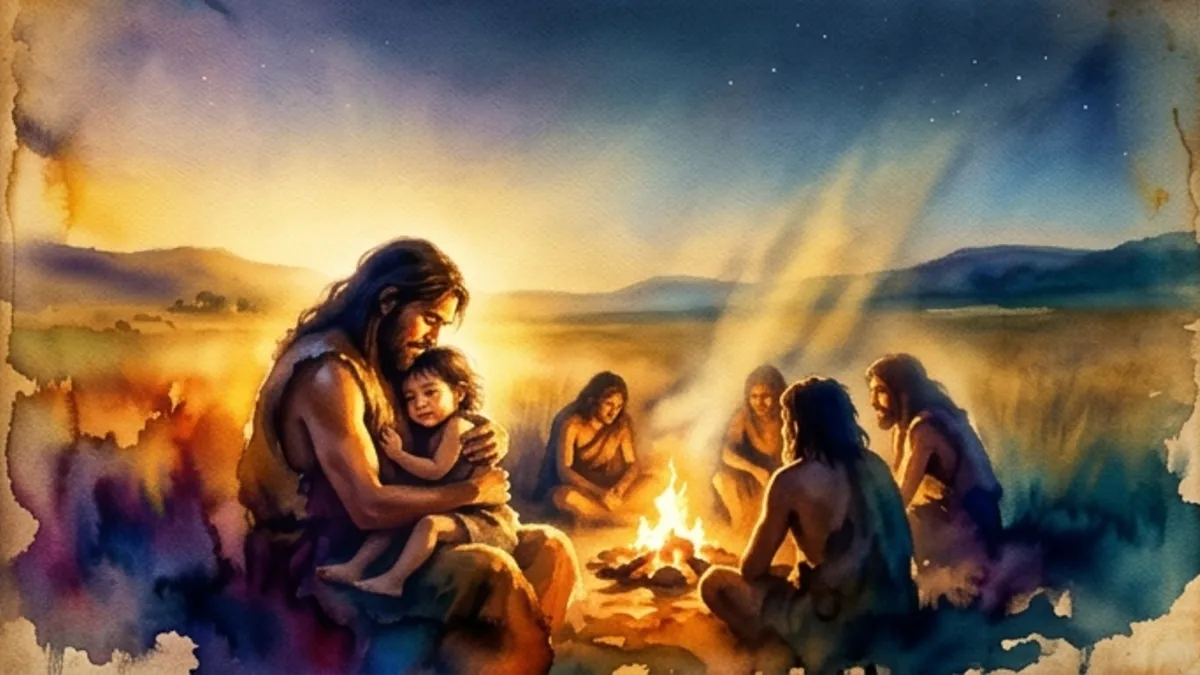
Picture the very end of the Earth's long story, the last seconds before midnight on the cosmic clock. After billions of years of fire, ocean and stone, after countless plants and animals, a creature opens its eyes, looks at another — and something never seen before enters the universe: it can love. Not merely feel warmth, not merely guard its young, but turn toward another on purpose. The Third Great Lesson tells this moment more softly than any other, and perhaps more deeply.
The quietest of all the gifts
The Third Great Lesson — the Coming of Human Beings — first hands children the visible gifts. The hand that came free to build and shape. The mind that can wonder at the wind it cannot see, at the stars, at where the rain comes from. The strange freedom not to be bound to one place and one way of living, so that a human can be at home in desert, ice and forest alike.
And then, almost in passing, comes the greatest gift — and it is the stillest. It is the power to mean another person. Not only to sense that someone is warm and familiar, the way an animal might, but to choose, freely, to be there for another — even for those far away, even for people we will never meet.
Children feel something change in that moment. A breath ago the story was about tools, inventions, the conquering of a whole planet — about skill and power. Now it turns to something altogether different, and the room grows quiet. For they understand: what truly makes a human a human is not an ability for mastering the world. It is the freedom to turn toward another and to mean it. And that gift they have carried inside them all along.
Why this moment changes children
Maria Montessori never meant the cosmic lessons as mere information. She wanted children to feel their place within the whole — and that includes the question of what they can give to the world. This is exactly where the moment of love takes hold. It shifts the gaze: away from "What can I achieve?" toward "Whom am I here for?"
That shift is precious. A child who grasps that its greatest gift lies not in winning or owning but in turning toward others meets the world differently. It learns that strength and tenderness belong together, and it feels both at once — gratitude for being loved, and wonder that it can love in return. You do not have to explain this gift. You can show it. Children learn to love not from words but from the way they themselves are meant — whether someone is truly there when they speak, whether their sorrow is taken seriously, whether they sense: I am wanted. As a supplementary resource for the Montessori practice, an impulse like this only points you back to that, beginning with the next small moment you share.
Try this at home: find one small moment today in which you want to teach your child nothing, fix nothing and finish nothing — but simply be wholly present. Two minutes of undivided attention, in which your child feels that it is meant, say more about the greatest human gift than any explanation.
When did you last turn to someone so completely that they could feel it: you are truly meant? And what might change for your child if it met this one gift in you every single day?