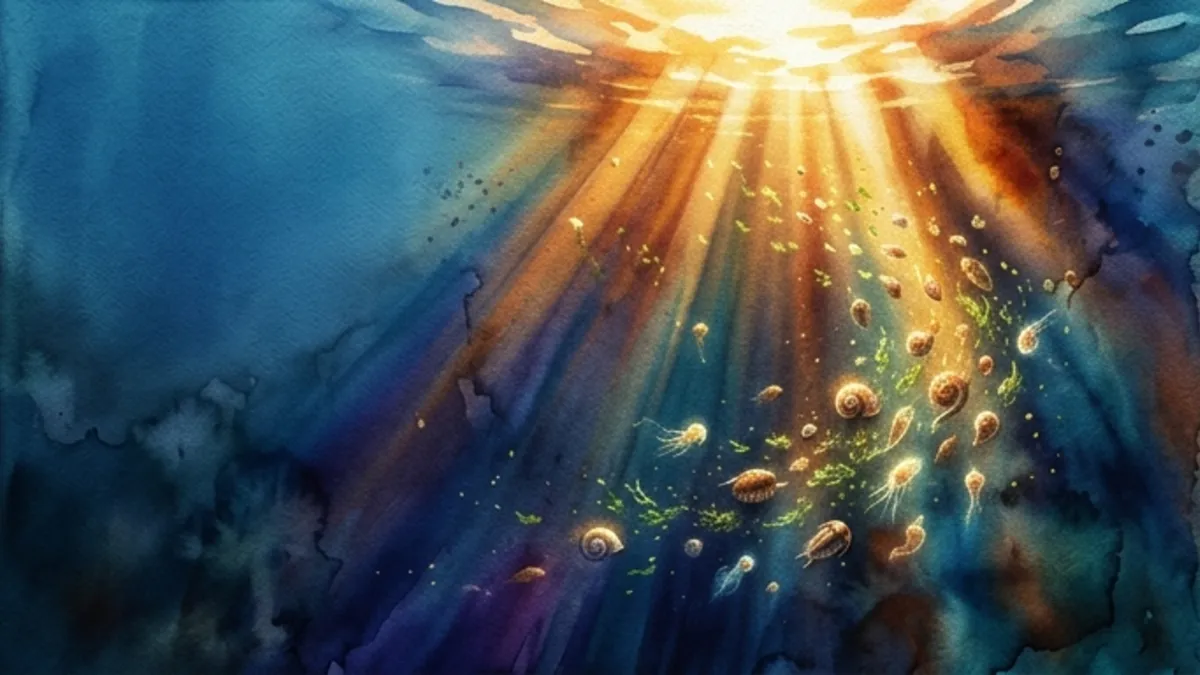
Picture the sea of the young Earth: vast, restless, thick with salt and ground-up stone. A planet that has only just become beautiful is tipping out of balance — and the great powers, sun and water, air and rock, stand by helplessly. Rescue, when it comes, comes from none of them. It comes from creatures so small that no eye could ever have caught sight of them. In the Second Great Lesson it is not the strongest who saves the world, but the smallest.
No one to blame, yet everything wobbles
The Second Great Lesson — the Coming of Life — opens with trouble. The young Earth, a shimmering pearl only moments ago, begins to change: acid rain gnaws at the mountains, storms hammer the coasts, and the seas grow ever heavier with salt and mineral. The order so painstakingly built starts to slip.
Then comes a scene children adore. The Sun calls the elements to account — and each one shrugs. Water has only followed its laws: it rises, it falls, it runs downhill. Air must wrap the planet and so can never hold still. The rocks answer dryly: and who, dear Sun, is heating us? Everyone does exactly what was asked of them, and still everything goes wrong. Children feel the comedy of this cosmic quarrel at once — and beneath it, something deep: there are troubles no one is guilty of.
And then the real thing happens. In the water, tiny beings appear with a wholly new gift: they can feed, grow and multiply. Life steps onto the stage — invisibly small. Green algae learn to make their own food from sunlight, and in doing so clean the air. Little shelled creatures draw salt and mineral from the sea to build their armour, which sinks to the seabed when they die. Simply by living, the smallest bring the Earth back into balance.
The cosmic task: each one serves the whole
Why does this moment move us so? Because it holds the heart of Cosmic Education in a single image: the cosmic task. Maria Montessori wanted children to see that every living thing — alga, earthworm or human — renders a service to the whole just by existing. The alga is not trying to save the world. It is only making its food. Yet by that very act the water clears, the air freshens, and everyone who comes after is handed the oxygen to breathe.
For a child between six and twelve this is a quiet revolution. In a world that so often praises the big, the loud and the strong, this story says the opposite: meaning has nothing to do with size. To be tiny is not to be dispensable. Children who sometimes feel small themselves listen to that very closely. And beneath it hums gratitude — the oxygen we breathe today was made by countless minute creatures over billions of years; whole cliffs of chalk are built from their shells. As a supplementary resource for the Montessori practice, an impulse like this simply hands that wonder back to you, to share.
Try this at home: go hunting with your child for today's invisible helpers — earthworms loosening the soil, bees carrying pollen, fungi turning fallen leaves into earth. At each one, ask together: what does it do, without ever knowing, for the whole? And a simple walk becomes a lesson in cosmic seeing.
Which small, unnoticed things keep your own life in balance — and what do you do, simply because it is your nature, that quietly serves others without your ever having planned it?