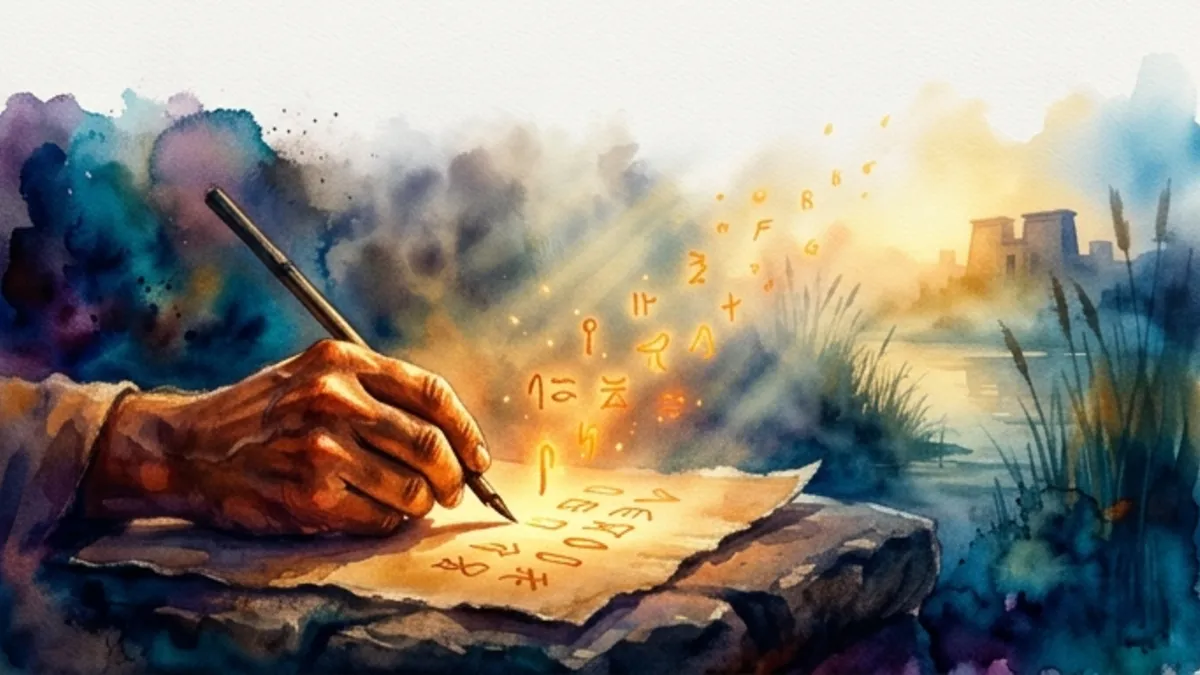
Right at this moment something astonishing is happening — and you barely notice it. As your eyes move across these lines, you are hearing the thoughts of a person you have never met. Perhaps they live in another country. Perhaps they lived a hundred years ago. Perhaps they were gone long before you were born. And still they are speaking to you, here in your own room, quite silently, without a single sound. No spell makes this possible, only one of the quietest inventions humankind ever made: writing. A handful of marks on a page — and a thought leaps over seas, over walls, over whole centuries.
The moment a mark stayed behind
The Fourth Great Lesson carries children back to a time when there were no books, no letters, not a single written word. Whoever discovered something that mattered — a stream full of fish, a safe path, a good place to hunt — could only tell the people who happened to be nearby. With hands, with sounds, mouth to mouth. But what if the others were far away? Then the news simply faded, unheard, into the wind.
Until someone — and to this day we do not know who — had a daring idea. Instead of calling out, this person scratched a picture into the sand, or into the face of a rock. A simple sign that spoke in their place, even once they themselves had walked on. For the very first time, a thought stayed behind while the human being moved away. It could now wait in one spot, patient as a stone, while its maker wandered off to other valleys and other years.
When children reach this moment in the story, the room often goes completely still. They sense that something enormous is beginning — not with thunder, but with a scratch in stone. They picture how simple pictures grew into the picture-writing of the Egyptians, how the Phoenicians had the bold idea of choosing one sign for each single sound, how across many peoples our alphabet slowly took shape. And suddenly they understand: every letter they themselves are learning to write is the end of an unimaginably long journey that began with one stroke in the sand. What was meant as a call across a short distance had quietly become a bridge across time itself.
The invention that overcomes time
The real wonder of writing is not that you can use it to jot down a shopping list. The wonder is that it defeats time. A spoken word lives for a single breath, and then it is gone. A written word, though, waits patiently — a thousand years, if it must — until at last someone comes along and reads it. A clay tablet does not grow tired; a line of ink does not forget. And in the instant a reader arrives, the old thought springs back to life, as fresh as if it had only just been thought.
For children this is one of the deepest experiences that cosmic education can offer, and, as a supplementary resource for the Montessori practice, it works something quiet and profound. They are not only learning to string letters together. They grasp that by writing they can send a message into the future — and that everything standing in a book is a message from the past, a gift from unknown people who did not want their knowledge to vanish along with them. Out of this insight two things grow at once: wonder at the invention, and gratitude towards all those who wrote before us. That is what makes learning to write so much larger than a school exercise — it is stepping into a chain that reaches from the first stroke in the sand all the way to this page, and far beyond us, into a future we will never see.
Try this today: write a letter together with your child — not to a person, but to the future. A few sentences about what life is like right now, what you love, what you are hoping for. Slip it into an envelope marked “Do not open for five years.” All at once the quiet miracle of writing becomes something you can hold in your hands.
If a single sentence of yours could outlast a thousand years, which one would you write down for a person you will never meet — and what does your choice reveal about what truly matters to you?