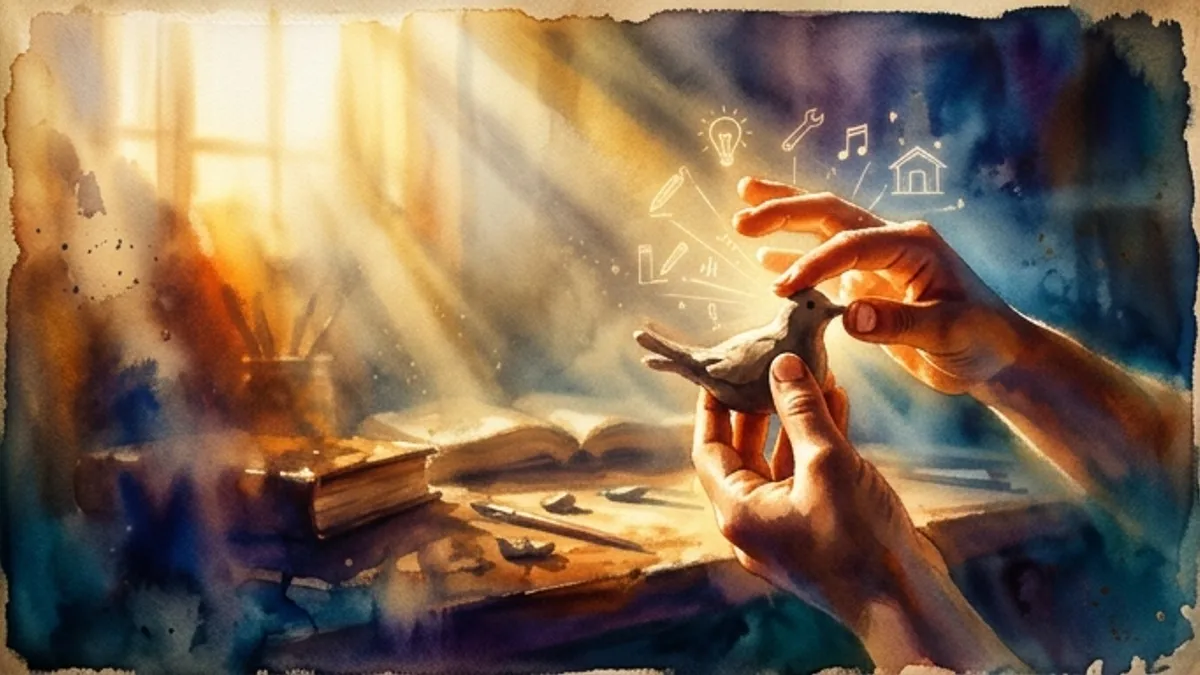
Watch a child trying to open a stubborn tin, balance two uneven pieces of wood, or thread a needle for the first time. The fingers pause, change their grip, return, and try again. Nothing has been explained aloud, yet a conversation is taking place. Pressure asks a question; resistance answers it. The eyes notice, the mind revises, and the hand tests the new idea. We often say that the child is “using their hands,” as though the hands were obedient helpers waiting for instructions. But what if, in moments like these, the hands themselves are part of the thinking?
The tool that was not already finished
The Third Great Lesson invites us to notice a peculiar human arrival. Other creatures come magnificently equipped for particular lives: the mole’s paws dig, the eagle’s talons seize, the beaver’s teeth cut. The human hand appears almost undecided by comparison. It is not the strongest claw, the fastest fin, or the sharpest blade. Its gift is openness. A thumb can meet the fingers; a palm can cup water; fingertips can hold a splinter of bone or feel the smallest ridge in clay. The same hand that lifts a stone can guide a brush, soothe a frightened child, knot a cord, or shape a sound on a violin.
Imagine one of our distant ancestors holding a broken stone. There is no manual and no finished tool to copy. The stone turns in the hand. An edge catches the light. The mind sees an action that has not happened yet: scrape, cut, open, build. Then the hand strikes. Perhaps the first attempt shatters. Perhaps the next leaves an edge. Thought becomes visible in a changed object, and that object returns new information to thought. The tool is not simply invented in the head and delivered by the fingers. It emerges through a loop of imagining, touching, failing, noticing, and trying again.
Across generations, that loop altered the world. Hands learned the patience of fibre, the grain of wood, the heat of fire, the weight of earth. They made shelters before architecture had a name and kept rhythm before music could be written down. Each successful gesture could be watched and repeated by another person. Knowledge travelled from body to body: in the angle of a wrist, the tension of a thread, the careful way a vessel was passed. Long before libraries, the human hand was already recording intelligence in things.
Let the fingers meet a real question
This moment matters in Montessori practice because children do not first become thinkers and only later become makers. Their understanding grows through movement from the beginning. A bead counted, a letter traced, a cloth wrung out, or a plant repotted gives the mind boundaries it can feel. The material answers honestly. A tower leans. Water spills. A knot holds or loosens. Such feedback is neither praise nor correction; it is reality helping the child refine an idea.
Adults can interrupt this partnership without meaning to. We demonstrate every step too quickly, replace a difficult tool with an effortless one, or finish the last awkward part because time is short. The result may look neat, but the most interesting thought has been removed. Productive difficulty is not the same as frustration. It is the small, reachable resistance that makes the hand curious: How else could I hold this? What if I turn it? Why did that collapse? A prepared environment offers tools that fit the child and enough time for an answer to arrive through action.
There is also humility in recognising thought made by hands. The chair beneath us, the zip on a coat, the spoon at breakfast, and the paving stone outside all contain choices made by people we may never meet. Drawing a child’s attention to those choices can awaken gratitude without a lecture. Someone measured this. Someone tested the hinge. Someone learned how much pressure the material would bear. Human history becomes less a parade of famous names and more a vast, shared workshop.
Try this in your setting: create a small “unfinished problem” tray with three safe materials—perhaps two pieces of card, a length of string, and a wooden peg—and one simple invitation: “Can you make something that stands and holds a small stone?” Do not provide a model. Let children test, dismantle, and begin again. Afterwards, ask them to show one discovery their hands made. Photograph or sketch the different solutions, not to rank them, but to make many forms of thinking visible.
When you next see a child’s hands hesitate over a difficult task, can you wait long enough to notice the thought forming there—and which part of your own impulse to help might need to become still?