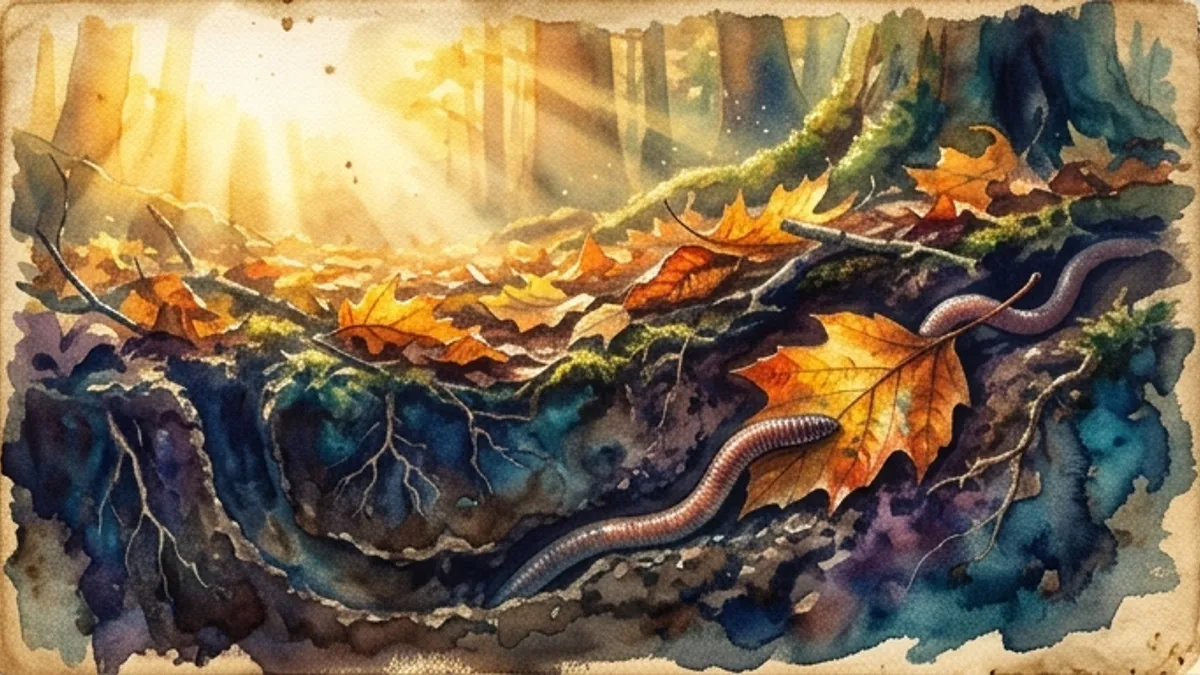
The path is busy with people going somewhere. Beside it, an earthworm disappears beneath a fallen leaf. You could step past this meeting a hundred times without noticing. Today, a child stops you. What is happening down there? A little patch of ground becomes a place worth studying, and the journey can wait. This is one of the gifts of the Second Great Lesson: it makes room for lives that seldom claim our attention. An animal feeds, moves and seeks shelter. Through those ordinary acts, its surroundings change. The great story has found a doorway beside your shoe.
Living things help shape the world they inhabit
There is a moment in the story of life's coming when the Earth ceases to feel like a stage with creatures placed upon it. Living things become part of the changing stage itself. Shell-building animals offer a particularly clear example. They take materials from their surroundings into protective structures. Over time, the remains of many such organisms can become part of sediments. An individual need and a wider consequence belong to the same picture.
Montessori's image of a cosmic task draws attention to that relationship. You might introduce it through a question rather than a definition: what changes around an animal while it gets on with living? The question is small enough for a child to investigate and large enough to lead beyond the first answer. Food, movement, shelter and other creatures begin to connect. A familiar animal acquires a life beyond its name on a card.
Return to the earthworm. Some species draw dead leaves into their burrows. Feeding and tunnelling move organic matter and soil, affecting conditions below the surface. Other earthworms live nearer the leaf litter or follow different habits. A child's first discovery may therefore be that the word “earthworm” covers several ways of living. Looking closely makes our initial picture richer, rather than proving that we already knew everything important.
The word “task” needs careful handling. The worm has not accepted a job from the forest. It is not planning next spring's plants. Its behaviour has effects, and those effects depend on the place and the organisms involved. An animal's value also reaches beyond its usefulness to people. We can keep the poetic image while telling children plainly that ecological relationships do not require an animal to understand a purpose.
Leave a little silence at this point in the Great Lesson. Instead of passing immediately to the next impressive creature, choose one and follow a connection. What does it take in? What does it leave behind? A child's suggestion can become the beginning of research. The story opens a field of questions; observation and good reference books help us explore it with greater care.
A contribution can be quiet
Children often meet a world that rewards visible results. The tallest tower, the quickest answer and the neatest page attract attention. Soil life offers another way of looking. A change can matter without being loud or spectacular. You can help a child notice a relationship without turning it into a competition about which creature is most important. The interest lies in discovering how several lives meet.
This also invites gratitude. A patch of ground becomes more than a surface to walk across. It holds needs, traces and ongoing exchanges. Gratitude may appear as a decision to leave a small area undisturbed, or as a new question about a leaf. It does not need to become a speech delivered by the adult. Let understanding grow through the child's own encounters and the pleasure of returning.
When you connect the idea with human life, leave room for freedom. Children do not have a fixed ecological function to fulfil. Their worth does not depend on being useful. They can choose a contribution, change their minds and ask for help. Setting out a chair for someone or caring for a shared plant can be meaningful precisely because it is chosen. Belonging comes before an expectation of service.
Try this together: Choose a small patch of leaf litter and watch for ten minutes without collecting animals. Draw what you can actually see: a creature, a hole, a leaf edge or a trail. On a separate page, record your guesses about food and shelter. Return a few days later and compare. Keep observations and guesses distinct, and let the child select one question to investigate in a book. An empty-looking patch can still offer changes worth noticing.
Which small life near you deserves a longer look today? Choose a place with a child and give it time. What connection might you discover between an animal's ordinary activity and its surroundings, and how could you explore that connection without disturbing the life you have begun to notice?