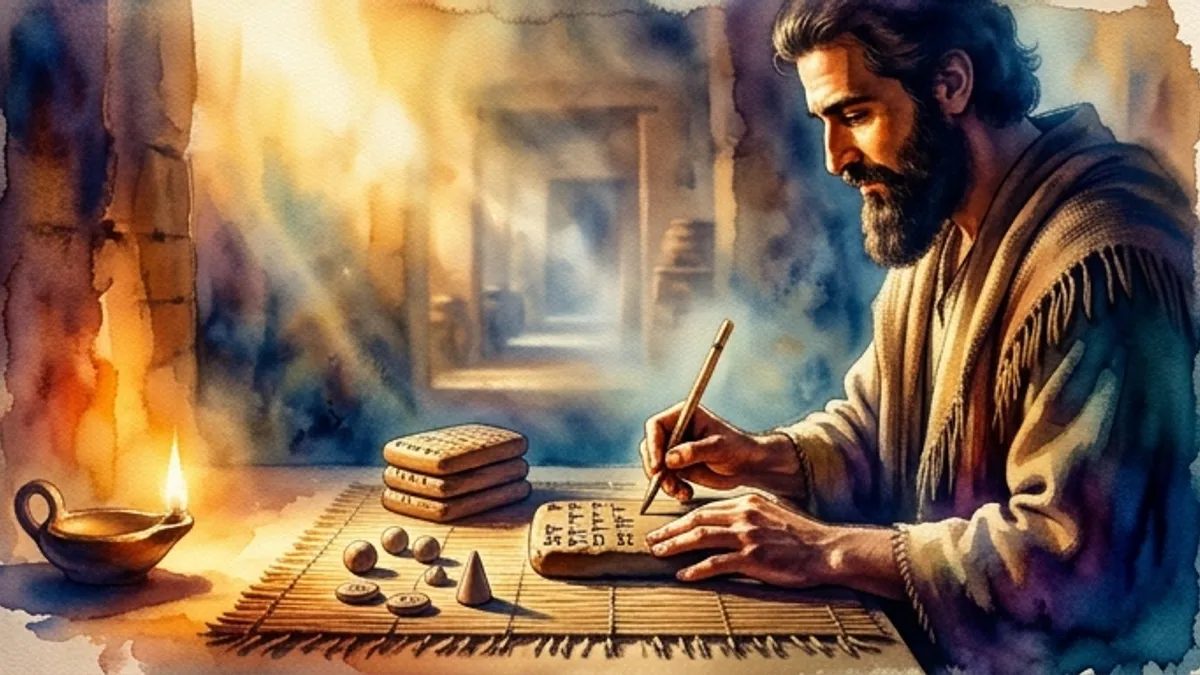
Imagine a merchant returning to a storehouse when the person who counted the grain has gone home. How many baskets arrived? How much bread was issued? Nobody needs to summon the accountant or trust a tired memory. On a small piece of clay, rows of quiet wedges are waiting. The hand that made them has vanished for the evening — and, thousands of years later, the whole city has vanished too. Yet the marks can still answer. They began as ordinary work, not as a message to the future. That is precisely what makes their long journey so astonishing.
When an account outlived the accountant
Before 3200 BCE, in the river country we now call southern Iraq, settlements were becoming busy enough to challenge the human memory. Grain entered storehouses, animals changed hands, and workers received measured rations of bread and beer. A spoken promise could serve two people standing face to face. It was less useful when goods moved between a field, a workshop, and a temple, or when several days passed before anyone checked the total. The earliest writing grew inside this practical difficulty. Many of its first surviving messages are accounts: quantities, commodities, names, and allocations.
The landscape offered an abundant writing surface. Clay could be shaped in the palm while moist, smoothed with a thumb, and marked with a cut reed. The reed did not glide like a pencil. Its angled end was pressed into the surface, leaving a triangular impression with a narrow tail. Repeated and turned, those impressions became the wedges that give cuneiform its modern name. Material and movement worked together: the shape of the tool helped shape the appearance of the script.
At first, many signs resembled the things being counted. Over generations, pictures were rearranged, simplified, and turned into increasingly abstract groups of wedges. Signs could carry words, ideas, syllables, or sounds, depending on the system and period. This matters because cuneiform was a script, not one language. Sumerian, Akkadian, Hittite, and several other languages were written with related cuneiform traditions during more than three thousand years of use.
Clay preserved these records unevenly. Many tablets were simply dried and could soften or break; some were deliberately baked, while others were fired by accident when buildings burned. The very fires that destroyed rooms could harden the records inside them. What survives is therefore a wonderfully untidy archive: contracts and deliveries, vocabulary lists, school exercises, legal decisions, hymns, letters, and calculations. Merchants and scribes did not set out to tell us who they were. They left the traces of what they needed to do, and everyday necessity crossed the millennia.
Writing as a promise between absent people
It is tempting to introduce writing through famous books. The clay tablets invite a different beginning. Writing first becomes visible as a social promise: this amount was delivered; this person received it; this is what we agreed. A mark allows people who are not in the same room — or even alive in the same century — to inspect one another's claims. The tablet does not remember as a person remembers. It does something more modest and sometimes more dependable: it keeps the trace still enough to be revisited.
For a child, that shift can make written language feel less like a collection of rules imposed by school. Every sign once answered a human problem. Someone teaching a young scribe needed an exercise that could be checked. The abstract wedge is easier to approach when we first see the busy hands, disputed totals, and wet clay behind it.
There is also a beautiful reversal here. Clay seems humble and vulnerable: it comes from underfoot, dents easily when wet, and may crumble when dry. Yet a quick digital note can disappear during an upgrade while a storehouse tally survives for five thousand years. Durability is not always designed. It may come from a material, an accident, and the patient work of people who later learn how to read the marks. As a supplementary resource for Montessori practice, this moment joins hand, mind, and community without turning history into a parade of isolated geniuses.
Try a clay account: flatten two palm-sized pieces of air-drying clay and cut the end of a clean reed or paper straw at an angle. Choose three real classroom goods — perhaps beans, buttons, and small cups — and let the child invent one sign for each. Press, rather than draw, a record of a tiny delivery into the first tablet. Ask another person to reconstruct the delivery from the marks, then improve the code on the second tablet. Leave one to dry; no firing is needed. The interesting part is not making “correct” cuneiform, but discovering what a record must reveal if an absent reader is to trust it.
If an archaeologist found only the small records of your ordinary week — lists, receipts, messages, and practice pages — what kind of life would those fragments describe? What would you hope they understood correctly, and which easily overlooked detail might reveal you most honestly?