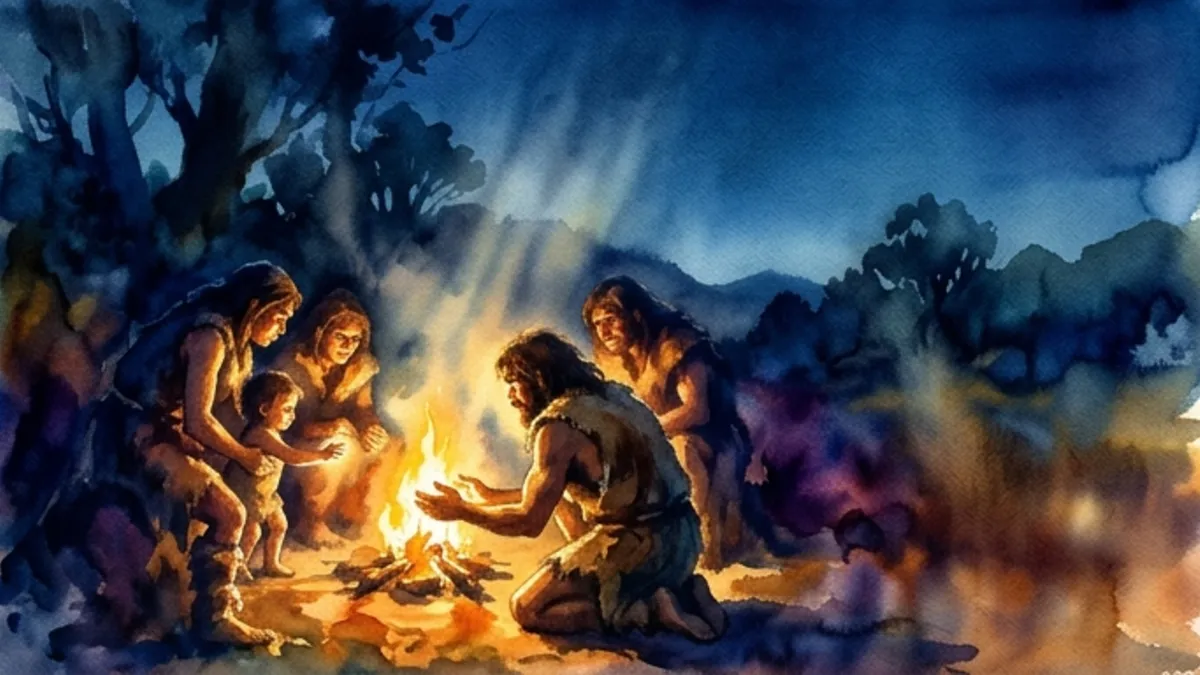
Picture a night with no lights at all — no lamp, no screen, no glow on the horizon. Only cold air and the sounds of animals you cannot see. For the first humans, night was something to fear and to survive. And then something extraordinary happened: a person held a flame instead of fleeing from it, fed it, guarded it, and carried it on. In that single moment the feared fire became a friend, and the endless dark became a place where you could actually stay.
The courage to keep a flame
In the Third Great Lesson, the child meets what makes the human being different: free hands, a wondering mind, and the freedom to turn toward another. The taming of fire is where all three gifts meet at once. Mastering fire was not a lucky accident but one of the bravest decisions our ancestors ever made.
First it took courage. Every animal flees from fire, and with good reason. The human being stopped instead. He watched a lightning-struck tree, an ember glowing in the earth, and dared to come closer rather than run. Then the hand went to work: lifting a burning branch, gathering dry wood, feeding the small flame so it would not die. And slowly the mind understood that fire could be kept, carried from place to place, and one day even made.
When this moment is told to children, something tender happens. They hold their breath when the first flame nearly goes out, and breathe again when it flares back to life. They feel that this was not merely a tool but a centre. Around the fire people drew close. It warmed their bodies, kept predators at a distance, made hard food eatable, and turned the endless, hostile dark into a small circle of light — a circle in which people told stories, comforted one another and made plans. For the first time they had a place they could call home.
And because a single flame was so precious, people learned to share it. They carried glowing coals from one camp to the next, passed them to neighbours, and lit many new fires from one. So the fire became not only the centre of a group but a bond between people who looked after each other, so that no one was left behind in cold and darkness. What one person had discovered was handed on from hand to hand and from generation to generation — a knowledge never lost again.
Why the circle of light still warms us
That ancient fire went out long ago, yet the circle it created has stayed. We carry it whenever we sit down together in the evening, light a candle, or gather around someone we love. As a supplementary resource for Montessori practice, this moment lets children feel a quiet connection: the warmth, safety and togetherness we take for granted are gifts from a long chain of courage and care.
There is a deep message in this. The taming of fire does not tell the story of a single hero, but of people who guard something and share it. A guarded flame belongs to no one alone; it shines for everyone who gathers near it. Keeping a fire asks for reliability, attention and generosity. So children learn that the greatest human abilities are not there to set us apart, but to pass warmth on. Whoever gives another person a place at the table, an open ear or a helping hand is, in a way, keeping that same ancient fire alive.
This is exactly what makes the moment strong today. A child does not have to be loud or remarkable to belong to that circle. It can practise reliability by tending something — a plant, an animal, a shared task — and discover that sharing does not make us poorer, but warmer. And it can feel that gratitude toward all the unknown people who kept the fire before us is a good beginning for reverence for life.
Try this today: in the evening, light a single candle and switch off the other lights for a moment. Let your child name who belongs to their "fire" today — who gave them warmth, safety or comfort. A small flame becomes a conversation about belonging.
When did you last give away a little of your own "fire" — some warmth, some shelter, some time — and notice that your light did not grow smaller, but the circle around you grew a little brighter?