Picture a world with not a single letter in it. No books, no notes, no message waiting on a screen. If someone had something to say, another person had to be standing close enough to hear it — and the moment the words left the mouth, they were gone. Then, on some unremembered day long ago, a human being bent down and pressed a picture into wet sand with a stick. For the very first time, a thought outlived the moment in which it was thought. That quiet, enormous beginning is where the Fourth Great Lesson opens.
When a picture became a message
In the story of how writing came to be, children travel back to a world with no shops, no houses as we know them, and not one written word. The first people were clever and full of imagination, and whenever they found something important — a stream full of fish, a place where fruit hung ripe — they told one another with gestures and sounds. That worked beautifully, as long as everyone was together. But what happened when the others were far away and still needed to know?
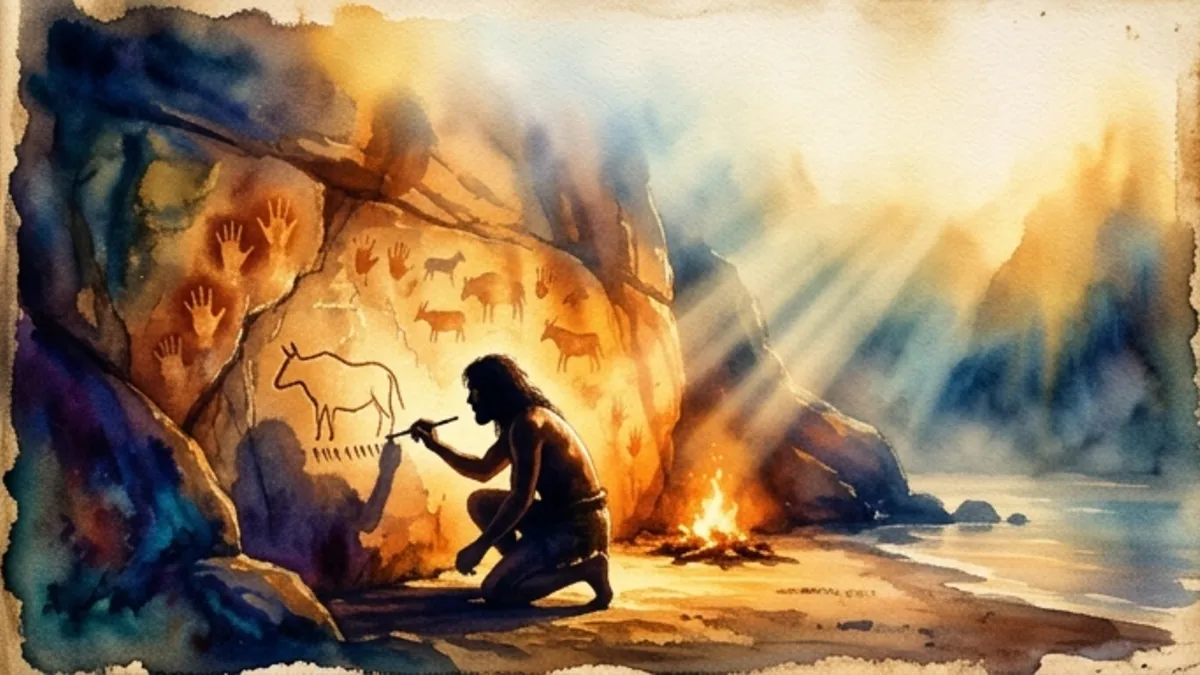
No one knows who did it first. Someone, one day, had the idea of simply recording what they wanted to say — in the sand, on a rock face. A drawing of an animal with a few strokes beneath it became a message: here I saw ten animals. Suddenly the news could stay in one place while the person who left it walked on. What had only ever travelled as sound through the air, vanishing at once, now had a body that remained. A picture could wait — a day, a summer, a whole lifetime.
Children feel the size of this idea the moment they hear it. They know that pictures really have been found on cave walls, in many lands across the Earth, some of them breathtakingly beautiful. That these marks are older than any story anyone could tell, and yet still speak to us — that makes them go quiet for a while. They understand something true: here a human being, much like them, decided to be seen across time. And this is the spark from which, over many thousands of years, first the picture-scripts, then signs for single sounds, and finally our alphabet would grow.
The wish to leave a trace
What moves me about this moment is not mainly the technique. It is the longing underneath it: to be heard, even when you are not there. In that first picture in the sand lies everything writing still is today — the courage to let a thought out of your own head and entrust it to the world. As a supplementary resource for Montessori practice, this is above all a lesson in gratitude. Each time a child writes their name now, they stand at the end of a long chain of people who all helped thoughts learn to travel — over mountains, over seas, across thousands of years.
This cosmic perspective takes the drudgery out of learning to write and gives it meaning. A child who senses what a priceless invention is being placed in their hand is not only practising letters; they are stepping into an ancient conversation of humankind. We grown-ups can nourish that wonder — less by explaining, more by marvelling alongside them. Show your child that every mark they make can be a small message to the future.
Try this today: go outside with your child and write a message together without any words — a stick in the sand, chalk on the pavement, stones laid out in a line. An animal, a few strokes, an arrow to a favourite place. Let someone who wasn't there read it, and watch how the picture begins to tell its own story.
If you could leave behind a single picture that would still speak to someone a thousand years from now, what would you carve into the stone?